Freshly Printed - allow 7 days lead
Couldn't load pickup availability
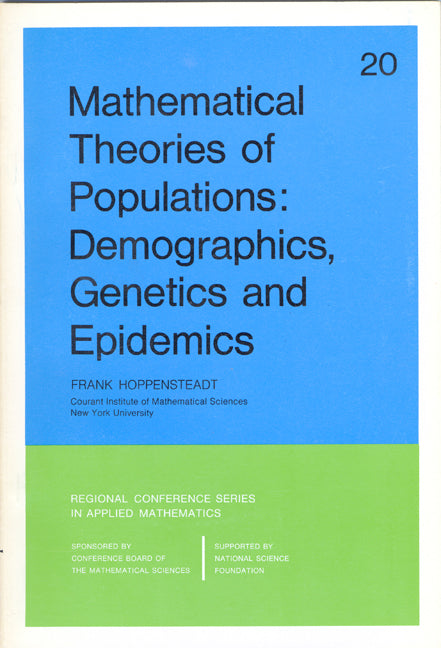
Mathematical Theories of Populations – Demographics, Genetics and Epidemics
Deomgraphics, Genetics, and Epidemics
A basic model in population age structure is studied and then applied and extended to several population phenomena.
Frank Hoppensteadt (Author)
9780898710175
Paperback / softback, published 28 February 1987
80 pages
25 x 17.4 x 1 cm, 0.17 kg
Mathematical theories of populations have appeared both implicitly and explicitly in many important studies of populations, human populations as well as populations of animals, cells and viruses. They provide a systematic way for studying a population's underlying structure. A basic model in population age structure is studied and then applied, extended and modified, to several population phenomena such as stable age distributions, self-limiting effects, and two-sex populations. Population genetics are studied with special attention to derivation and analysis of a model for a one-locus, two-allele trait in a large randomly mating population. The dynamics of contagious phenomena in a population are studied in the context of epidemic diseases.
The Equations of Population Dynamics: Age Dependent Population Growth
Analysis of the Birth Rate
A Model of a Self-Limiting Population
A Two-sex Model
Deterministic Models in Genetics: A Brief Introduction to Mendelian Genetics
The One-Locus, two-allele Model
Age Dependent Population Genetics. Propagation of a Gene in a Spatially Distributed Population
Theories of Epidemics: General Theory of Contagious Phenomena
Qualitative Behavior of Deterministic Epidemics.
Subject Areas: Miscellaneous items [WZ]