Freshly Printed - allow 7 days lead
Couldn't load pickup availability
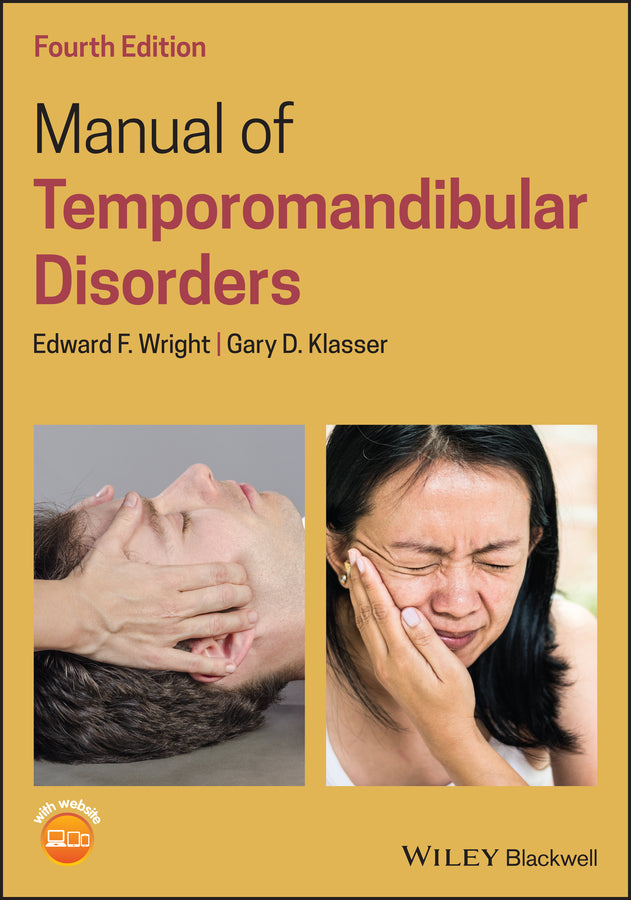
Manual of Temporomandibular Disorders
Edward F. Wright (Author), Gary D. Klasser (Author)
9781119548843, Wiley
Paperback / softback, published 8 October 2019
416 pages
25.4 x 17.8 x 2 cm, 0.885 kg
Fully updated with the latest information in the field, this comprehensive book provides a practical guide to diagnosing and managing temporomandibular disorders in the dental practice. Written in an accessible, user-friendly style, it offers a simplified approach to the basic concepts and management decision points for the most commonly observed temporomandibular conditions, integrating the latest advances and advice throughout. Quick Consult, Focal Point, and Technical Tip boxes provide quick access to relevant information, and study results are summarized in graphs for ease of comprehension. Manual of Temporomandibular Disorders, Fourth Edition examines an array of medical and dental conditions that affect the temporomandibular joint (TMJ), masticatory muscles, and contiguous structures. It presents evidence-based, clinically practical information to help dentists diagnose TMD accurately, rule out disorders that mimic TMD, and provide effective therapy for most patients. Special features include: Manual of Temporomandibular Disorders, Fourth Edition is a must-have how-to manual for general dentists, dental students, and residents involved in this area of practice.
Preface xiii Introduction 1 Part I Initial Evaluation 5 1 Patient Interview 9 2 Review of the "Initial Patient Questionnaire" 29 3 Clinical Examination 35 4 Imaging 69 5 TMD Diagnostic Categories 79 6 Contributing Factors 95 Part II Common Acute TMD Conditions and Therapies 101 7 TMD Secondary to Trauma 103 8 TMD Secondary to Dental Treatment 107 9 Lateral Pterygoid Spasm 123 10 Intermittent and Continuous Forms of TMJ Disc Displacement Without Reduction with Limited Opening 129 11 TMJ Subluxation and Luxation 145 Part III Occlusal Appliance Therapy 149 12 Stabilization Appliance 153 13 Anterior Positioning Appliance 209 Part IV Multidisciplinary Management Approach 219 14 Self-Management Therapy 223 15 Physical Medicine 241 16 Cognitive-Behavioral Intervention 255 17 Pharmacological Management 269 18 Other Dental Procedures 291 19 Integrating Multidisciplinary Therapies 309 Part V Case Scenarios 327 Part VI Fundamentals of Clinical Studies 359 References 369
About the Companion Website xv
3.1 Range of Motion 36
3.2 TMJ Noise 39
3.3 TMD Palpations 40
3.4 Intraoral Examination 57
3.5 Additional Evaluations 63
4.1 Plain Radiographs 70
4.2 Panoramic Radiograph 70
4.3 Axially Corrected Sagittal Tomography 71
4.4 CT 71
4.5 CBCT 72
4.6 MRI 72
4.7 Arthrography 72
4.8 Ultrasound 72
4.9 Imaging Strategies 73
4.10 Imaging Recommendations 73
5.1 TMJ Disorders 80
5.2 Masticatory Muscle Disorders 88
5.3 Headache Disorders 91
5.4 Associated Structures 91
8.1 Preventing Aggravation from Dental Treatment 110
8.2 Medial Pterygoid Muscle Pain 112
8.3 Inability to Close into MI 114
8.4 Occlusal Interference Sequelae 116
8.5 OSA Appliances 118
10.1 Intermittent Disorder (Disc Displacement with Reduction with Intermittent Locking) 131
10.2 Continuous Disorder (Disc Displacement Without Reduction with Limited Opening, Also Known as Closed Lock) 134
12.1 Mandibular Positions and Interocclusal Record 155
12.2 Physical Variables 159
12.3 Appliance Adjustments 171
12.4 Appliance Examples 188
12.5 Appliance Management 200
13.1 Mandibular Position and Interocclusal Record 211
13.2 Design and Adjustments 212
13.3 Appliance Management 213
14.1 Self-Management Instructions 224
14.2 Closure Muscle-Stretching Exercise 230
14.3 Lateral Pterygoid Muscle-Stretching Exercise 231
14.4 Posture Exercises 233
14.5 Controlling Awake Behaviors 234
15.1 Muscle Massage 242
15.2 Yoga 242
15.3 Trigger-Point Compression 243
15.4 Trigger-Point Injection 243
15.5 Botulinum Toxin Injections 244
15.6 Physical Therapy 244
15.7 Acupuncture 248
15.8 Chiropractics 249
16.1 Controlling Awake Behaviors 259
16.2 Relaxation 261
16.3 Hypnotherapy (Hypnosis) 262
16.4 Biofeedback-Assisted Relaxation 263
16.5 Stress Management 264
17.1 Analgesics 270
17.2 Anti-inflammatory Medications 271
17.3 Muscle Relaxants 274
17.4 Anticonvulsant 275
17.5 Tricyclic Antidepressants 276
17.6 Topical Medications 278
17.7 Nutritional Supplements 283
18.1 Occlusal Equilibration 294
18.2 Orthodontic–Orthognathic Therapy 296
18.3 Prosthodontic Therapy 297
18.4 TMJ Surgery and Implants 299
19.1 Management Summaries and Clinical Implications 310
19.2 Integrating Conservative Therapies 316
19.3 TMD Refractory to Initial Therapy 320
19.4 Long-Term Management 321
V.1 Case 1: Symptomatic Irreversible Pulpitis Mimicking TMD Symptoms 329
V.2 Case 2: Tooth Pain: No TMD Pain 331
V.3 Case 3: Chronic Sinusitis 332
V.4 Case 4: Chronic Forehead Pain Referred from the Neck 333
V.5 Case 5: Myalgia Secondary to Sleep Parafunctional Behaviors 335
V.6 Case 6: Tooth Attrition: No Pain 336
V.7 Case 7: Myalgia Secondary to Awake Parafunctional Behaviors 337
V.8 Case 8: Medial Pterygoid Spasm 338\
V.9 Case 9: Personal Stressors and Sleep Disturbances as Contributing Factors 339
V.10 Case 10: Fibromyalgia as a Contributing Factor 340
V.11 Case 11: TMJ Disc–Condyle Complex Disorders and When to Provide Therapy: no Pain 341
V.12 Case 12: TMJ Arthralgia 342
V.13 Case 13: TMJ Disc Displacement with Reduction with Intermittent Locking 343
V.14 Case 14: TMJ Disc Displacement Without Reduction with Limited Opening: Unlocked 345
V.15 Case 15: TMJ Disc Displacement Without Reduction with Limited Opening: Not Unlocked 346
V.16 Case 16: Osteitis Causing Inability to Open Wide 348
V.17 Case 17: Lateral Pterygoid Spasm 350
V.18 Case 18: Acute Exacerbation of TMD 352
V.19 Case 19: Multiple Forms of Head and Neck Pain After Crown Insertion 354
V.20 Case 20: Appliance That Positioned Condyles into Their "Proper Position" 355
VI.1 Prominent Clinical Study Designs 359
VI.2 Other Types of Publications 367
VI.3 Considerations in Assessing Clinical Trials 368
VI.4 Conclusions 368
Glossary 373
Index 377
Subject Areas: Other branches of medicine [MM]