Freshly Printed - allow 8 days lead
Couldn't load pickup availability
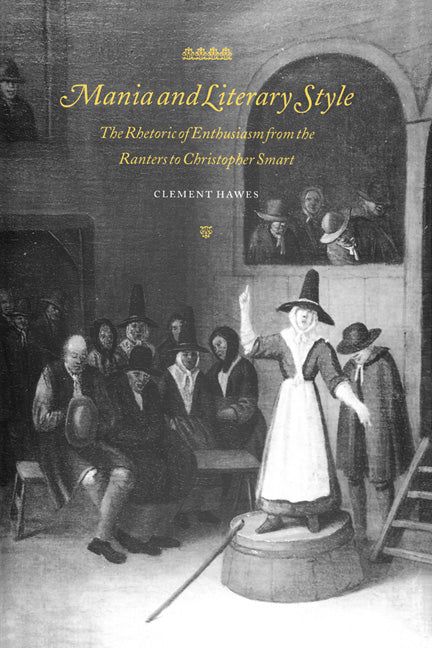
Mania and Literary Style
The Rhetoric of Enthusiasm from the Ranters to Christopher Smart
This study analyzes 'enthusiastic' writing from the Ranters to Swift, and explores madness and sanity in literature.
Clement Hawes (Author)
9780521550222, Cambridge University Press
Hardback, published 26 January 1996
256 pages
22.9 x 15.2 x 1.9 cm, 0.495 kg
"Clement Hawes's outstanding new book on the history of literary enthusiasm has arrived. Mania and Literary Style is a provocative and exciting account." Studies in Romanticism
This highly original study of the 'manic style' in enthusiastic writing of the seventeenth and eighteenth centuries identifies a literary tradition and line of influence running from the radical visionary and prophetic writing of the Ranters and their fellow enthusiasts to the work of Jonathan Swift and Christopher Smart. Clement Hawes offers a counterweight to recent work which has addressed the subject of literature and madness from the viewpoint of contemporary psychological medicine, putting forward instead a stylistic and rhetorical analysis. He argues that the writings of dissident 'enthusiastic' groups are based in social antagonisms; and his account of the dominant culture's ridicule of enthusiastic writing (an attitude which persists in twentieth-century literary history and criticism) provides a powerful and daring critique of pervasive assumptions about madness and sanity in literature.
Introduction: mania as rhetoric
Part I. Defiant Voice: 1. 'Howl, you great ones': enthusiastic subjectivity as class rhetoric
2. 'A huge loud voice': leveling and the gendered body politic
3. Strange acts and prophetic pranks: apocalypse as process in Abiezer Coppe
Part II. Patrician Diagnosis: 4. Return to madness: mania as plebeian vapors in Swift
Part III. Beautiful Liminality: 5. Scribe-evangelist: popular writing and enthusiasm in Smart's Jubilate Agno
6. Double jeopardy: the provenance and reception of Jubilate Agno
7. Smart's bawdy politic: misogyny and the second Age of Horn in Jubilate Agno
8. Smart's poetics of place: myth versus utopia in Jubilate Agno
Epilogue: beyond pathology.
Subject Areas: Literary studies: poetry & poets [DSC]