Freshly Printed - allow 7 days lead
Couldn't load pickup availability
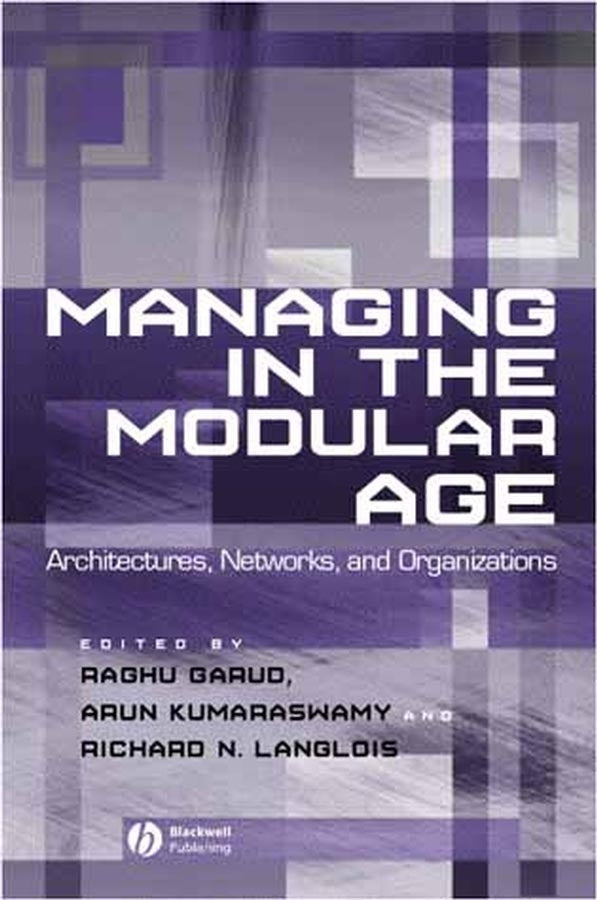
Managing in the Modular Age
Architectures, Networks, and Organizations
Raghu Garud (Edited by), R Garud (Author), Arun Kumaraswamy (Edited by), Richard Langlois (Edited by)
9780631233169, Wiley
Paperback / softback, published 13 September 2002
420 pages
24.9 x 17.3 x 3.3 cm, 0.753 kg
"This is a very topical issue… and this reader will be very welcome.… The list of people that the editors have lined up is simply outstanding. Their work in this area and their updates will be invaluable." Professor Peter Karnoe, Copenhagen Business School "The selection of readings is good, and it is pertinent: modularity is becoming an increasingly important subject." Professor Max Boisot, ESADE, Spain
This book brings together seminal articles by leading scholars of technological and organizational systems, exploring the impact of 'modularity'. Modularity refers to an ability to take apart and put together differenct products and networks, or to 'mix and match' components in order to meet different user specifications. This is of key importance today where new systems such as the World Wide Web and many areas of the computer industry depend on it. The volume pulls together and defines an exciting new area of inquiry: into how our 'modular age' is reshaping the business eco-system.
Acknowledgments. Introduction: Managing in The Modular Age: Architectures, Networks and Organizations. (R. Garud, A. Kumaraswamy, R. Langlois). Part I: Overview. 1. The Architecture of Complexity. (H. A. Simon). Commentary. (M. Augier and H. A. Simon). 2. Technological and Organizational Designs to Achieve Economies of Substitution. (R. Garud and A. Kumaraswamy). Commentary. 3. Networks And Innovation In A Modular System: Lessons From The Microcomputer And Stereo Component Industries. (R. N. Langlois and P. L. Robertson). Commentary. Part II: Modularity And Architectures. 4. The Role of Product Architecture in the Manufacturing Firm. (K. Ulrich). Commentary. 5. Managing in an Age of Modularity. (C. Y. Baldwin and K. B. Clark). Commentary. 6. Towards a General Modular Systems Theory and Its Application to Interfirm Product Modularity. (M. A. Schilling). Commentary. Part III: Networks And Standards. 7. The Economics of Networks. (N. Economides). Commentary. 8. The Art of Standards Wars. (C. Shapiro and H. R. Varian). Commentary. Part IV: Field-Level And Organizational Dynamics. 9. Dynamics of Organizational Communities and Technological Bandwagons: An Empirical Investigation of Community Evolution in the Microprocessor Market. (J. Wade). Commentary. 10. Dominant Designs, Technological Cycles and Organizational Outcomes. (M. L. Tushman and J. P. Murmann). Commentary. (G. Westerman and M. L. Tushman). 11. Modularity, Flexibility and Knowledge Management in Product and Organizational Design. (R. Sanchez and J. T. Mahoney). Commentary. (R. Sanchez). Index.
Subject Areas: Business & management [KJ]