Special Order - allow 2+ weeks lead
Couldn't load pickup availability
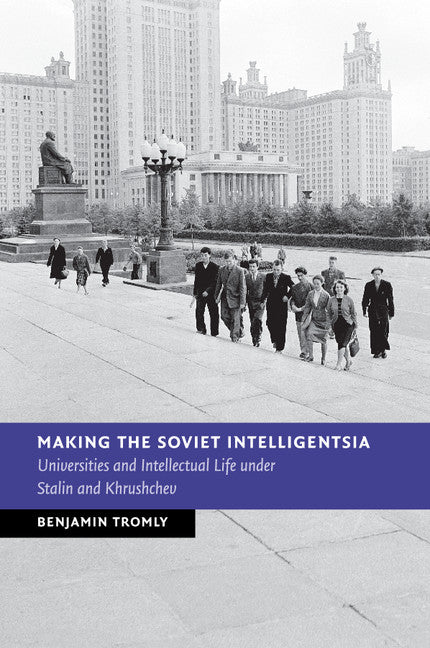
Making the Soviet Intelligentsia
Universities and Intellectual Life under Stalin and Khrushchev
A study of the shaping of the postwar Soviet intelligentsia and its ambiguous relationship with the Soviet project.
Benjamin Tromly (Author)
9781107595347, Cambridge University Press
Paperback / softback, published 26 November 2015
310 pages
9 x 6 x 0.4 cm, 0.45 kg
'… the two decades on which Making the Soviet Intelligentsia focuses are among the most interesting and eventful in the entire history of Soviet higher education. This thorough and elegant study does them justice and should remain a key work on the subject for many years to come.' Polly Jones, The Journal of Modern History
Making the Soviet Intelligentsia explores the formation of educated elites in Russian and Ukrainian universities during the early Cold War. In the postwar period, universities emerged as training grounds for the military-industrial complex, showcases of Soviet cultural and economic accomplishments and valued tools in international cultural diplomacy. However, these fêted Soviet institutions also generated conflicts about the place of intellectuals and higher learning under socialism. Disruptive party initiatives in higher education - from the xenophobia and anti-Semitic campaigns of late Stalinism to the rewriting of history and the opening of the USSR to the outside world under Khrushchev - encouraged students and professors to interpret their commitments as intellectuals in the Soviet system in varied and sometimes contradictory ways. In the process, the social construct of intelligentsia took on divisive social, political and national meanings for educated society in the postwar Soviet state.
Introduction
Part I. Universities and Postwar Soviet Society: 1. Youth and timelessness in the Palaces of Science
2. University learning in the Soviet social imagination
Part II. The Emergence of Stalin's Intelligentsia, 1948–56: 3. Making intellectuals cosmopolitan: Stalinist patriotism, anti-Semitism and the intelligentsia
4. Stalinist science and the fracturing of academic authority
5. De-Stalinization and intellectual salvationism
Part III. Revolutionary Dreaming and Intelligentsia Divisions, 1957–64: 6. Back to the future: populist social engineering under Khrushchev
7. Uncertain terrain: the intelligentsia and the thaw
8. Higher learning and the nationalization of the thaw
Conclusion: intellectuals and Soviet socialism
Note on oral history interviews
Bibliography.
Subject Areas: The Cold War [HBTW], Postwar 20th century history, from c 1945 to c 2000 [HBLW3], European history [HBJD]