Freshly Printed - allow 7 days lead
Couldn't load pickup availability
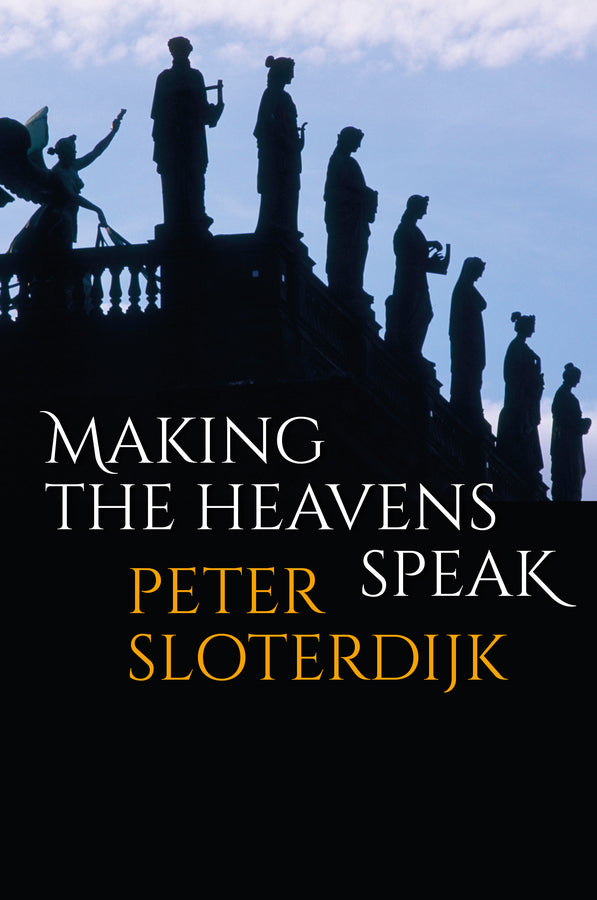
Making the Heavens Speak
Religion as Poetry
Peter Sloterdijk (Author), Robert Hughes (Translated by)
9781509547500, Polity Press
Paperback / softback, published 16 December 2022
288 pages
22.9 x 15.2 x 2.3 cm, 0.454 kg
"Religion is poetry, poetry is religion, and both are concerned with the 'overarching' that is at once cosmic and political. The avatars of this triple connectivity, and what happens to it when the overarching becomes paradoxically contested, are brilliantly explored in this new book. Agree with Peter Sloterdijk or not, he will assist you to think further about what is truly fundamental to our human existence and its future." "Sloterdijk once again proves to both his followers and his critics that the reputation of his work as a rich set of traditions of intellectual inquiry [. . .] is justified."
—John Milbank, University of Nottingham
—Meta: Research in Hermeneutics, Phenomenology and Practical Philosophy
The idea of a connection between poetry and religion is as old as civilization. Homer consulted the Olympian gods on the fate of the fighters on the plain before Troy, and the poet made the heavenly ones speak. It was through poetry that the gods were brought within reach of human hearing. In the centuries after Homer, the Athenian stage became the setting where gods made their poetic interventions, resolving human impasses and contributing to the emotional synchronization of the public life of the city. Sloterdijk argues that, as with the culture of the Ancient Greeks, all religions inscribe a kind of “theopoetry” at the heart of their cultural life and thought, even as they strenuously obscure these poetic origins through the cultivation and enforcement of orthodox norms. Sloterdijk also shows how, in conditions of religious pluralism, religions poetically reshape themselves to accommodate the demands of the religious marketplace. This highly original study of the poetic devices that inform accounts of the otherworldly offers a new interpretation of religious practice and its theological elaboration through history, as well as a fresh perspective on our contemporary age in which collective life, interwoven with imaginative fabrications, is fraying under critical stress.
Acknowledgements Preface I Deus ex machina, Deus ex cathedra 1 The gods in the theater 2 Plato's contestation 3 Of the true religion 4 Representing God, being God: an Egyptian solution 5 On the best of all possible heaven dwellers 6 Poetries of power 7 Dwelling in plausibilities 8 The theopoetical difference 9 Revelation whence? 10 The death of the gods 11 'Religion is unbelief': Karl Barth's intervention 12 In the garden of infallibility: Denzinger’s world II Under the high heavens 13 Fictive belonging together 14 Twilight of the gods and sociophany 15 Glory: poems of praise 16 Poetry of patience 17 Poetry of exaggeration: religious virtuosos and their excesses 18 Kerygma, propaganda, supply-side offense, or, When fiction is not to be trifled with 19 On the prose and poetry of the search 20 Religious freedom In lieu of an afterword Notes Index
Subject Areas: Philosophy [HP]