Freshly Printed - allow 7 days lead
Couldn't load pickup availability
Magnetotails in the Solar System
Andreas Keiling (Edited by), Caitríona Jackman (Edited by), Peter Delamere (Edited by)
9781118842348, Wiley
Hardback, published 24 March 2015
424 pages
28.7 x 22.4 x 2.7 cm, 1.383 kg
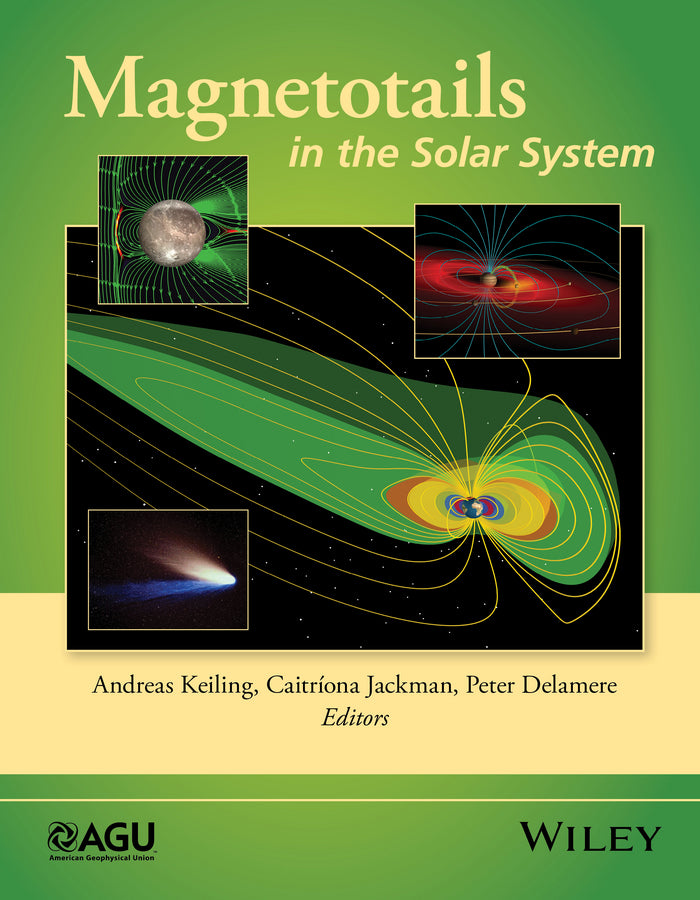
All magnetized planets in our solar system (Mercury, Earth, Jupiter, Saturn, Uranus, and Neptune) interact strongly with the solar wind and possess well developed magnetotails. It is not only the strongly magnetized planets that have magnetotails. Mars and Venus have no global intrinsic magnetic field, yet they possess induced magnetotails. Comets have magnetotails that are formed by the draping of the interplanetary magnetic field. In the case of planetary satellites (moons), the magnetotail refers to the wake region behind the satellite in the flow of either the solar wind or the magnetosphere of its parent planet. The largest magnetotail of all in our solar system is the heliotail, the “magnetotail” of the heliosphere. The variety of solar wind conditions, planetary rotation rates, ionospheric conductivity, and physical dimensions provide an outstanding opportunity to extend our understanding of the influence of these factors on magnetotail processes and structures. Volume highlights include: Collectively, Magnetotails in the Solar System brings together for the first time in one book a collection of tutorials and current developments addressing different types of magnetotails. As a result, this book should appeal to a broad community of space scientists, and it should also be of interest to astronomers who are looking at tail-like structures beyond our solar system.
Contributors vii Preface Section I: Introduction 1 Magnetotail: Unsolved Fundamental Problem of Magnetospheric Physics Section II: Tutorials 2 Mercury’s Magnetotail 3 Magnetotails of Mars and Venus 4 Earth’s Magnetotail 5 Jupiter’s Magnetotail 6 Saturn’s Magnetotail 7 Magnetotails of Uranus and Neptune 8 Satellite Magnetotails 9 Moon’s Plasma Wake 10 Physics of Cometary Magnetospheres 11 Heliotail Section III: Specialized Topics 12 Formation of Magnetotails: Fast and Slow Rotators Compared 13 Solar Wind Interaction with Giant Magnetospheres and Earth’s Magnetosphere 14 Solar Wind Entry Into and Transport Within Planetary Magnetotails 15 Magnetic Reconnection in Different Environments: Similarities and Differences 16 Origin and Evolution of Plasmoids and Flux Ropes in the Magnetotails of Earth and Mars 17 Current Sheets Formation in Planetary Magnetotail 18 Substorms: Plasma and Magnetic Flux Transport from Magnetic Tail into Magnetosphere 19 Injection, Interchange, and Reconnection: Energetic Particle Observations in Saturn’s Magnetosphere 20 Radiation Belt Electron Acceleration and Role of Magnetotail 21 Substorm Current Wedge at Earth and Mercury 22 Review of Global Simulation Studies of Effect of Ionospheric Outflow on Magnetosphere-Ionosphere System Dynamics Index 393
Andreas Keiling, Caitríona Jackman, and Peter Delamereix
Vytenis M Vasyliūnas 3
T Sundberg and J A Slavin 23
E Dubinin and M Fraenz 43
Robert L McPherron 61
Norbert Krupp , Elena Kronberg , and Aikaterini Radioti 85
Caitríona M Jackman 99
C S Arridge 119
Xianzhe Jia 135
J S Halekas, D A Brain and M Holmström 149
Tamas I Gombosi 169
David J McComas 189
D J Southwood 199
P A Delamere 217
Simon Wing and Jay R Johnson 235
Michael Hesse, Nicolas Aunai, Masha Kuznetsova, Seiji Zenitani, and Joachim Birn 259
J P Eastwood and S A Kiehas 269
Antonius Otto, Min-Shiu Hsieh, and Fred Hall IV 289
Gerhard Haerendel 307
D G Mitchell, P C Brandt, J F Carbary, W S Kurth, S M Krimigis, C Paranicas, Norbert Krupp, D C Hamilton, B H Mauk, G B Hospodarsky, M K Dougherty, and W R Pryor 327
Geoffrey D Reeves 345
L Kepko, K-H Glassmeier, J A Slavin, and T Sundberg 361
M Wiltberger 373
Subject Areas: Earth sciences [RB]