Freshly Printed - allow 10 days lead
Couldn't load pickup availability
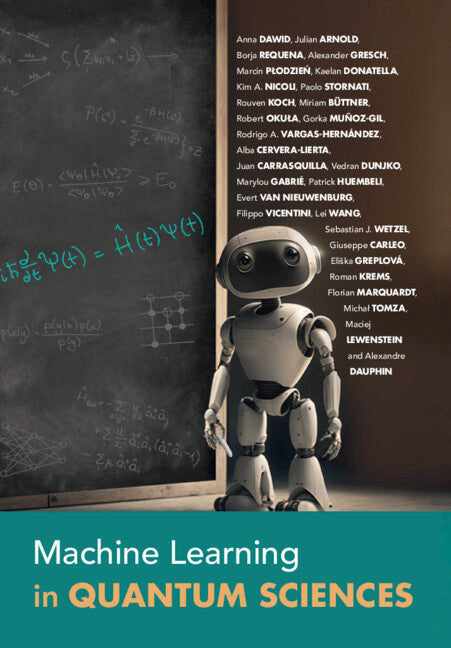
Machine Learning in Quantum Sciences
Provides a comprehensive introduction to the key concepts of machine learning and explores its applications in the quantum sciences.
Anna Dawid (Author), Julian Arnold (Author), Borja Requena (Author), Alexander Gresch (Author), Marcin Płodzień (Author), Kaelan Donatella (Author), Kim A. Nicoli (Author), Paolo Stornati (Author), Rouven Koch (Author), Miriam Büttner (Author), Robert Okuła (Author), Gorka Muñoz-Gil (Author), Rodrigo A. Vargas-Hernández (Author), Alba Cervera-Lierta (Author), Juan Carrasquilla (Author), Vedran Dunjko (Author), Marylou Gabrié (Author), Patrick Huembeli (Author), Evert van Nieuwenburg (Author), Filippo Vicentini (Author), Lei Wang (Author), Sebastian J. Wetzel (Author), Giuseppe Carleo (Author), Eliška Greplová (Author), Roman Krems (Author), Florian Marquardt (Author), Michał Tomza (Author), Maciej Lewenstein (Author), Alexandre Dauphin (Author)
9781009504935, Cambridge University Press
Hardback, published 12 June 2025
330 pages
26 x 18.5 x 2.3 cm, 0.81 kg
'This book is a valuable contribution to the field, striking a thoughtful balance between being self-contained and providing a broad survey of the different research directions. For physics students new to machine learning, the book can serve as an excellent entry point as it covers the essential foundational concepts. Likewise, experienced physicists already incorporating machine learning into their research will benefit from its well-curated overview of this rapidly evolving field.' Miranda Cheng, University of Amsterdam, Netherlands and Academia Sinica, Taiwan
Artificial intelligence is dramatically reshaping scientific research and is coming to play an essential role in scientific and technological development by enhancing and accelerating discovery across multiple fields. This book dives into the interplay between artificial intelligence and the quantum sciences; the outcome of a collaborative effort from world-leading experts. After presenting the key concepts and foundations of machine learning, a subfield of artificial intelligence, its applications in quantum chemistry and physics are presented in an accessible way, enabling readers to engage with emerging literature on machine learning in science. By examining its state-of-the-art applications, readers will discover how machine learning is being applied within their own field and appreciate its broader impact on science and technology. This book is accessible to undergraduates and more advanced readers from physics, chemistry, engineering, and computer science. Online resources include Jupyter notebooks to expand and develop upon key topics introduced in the book.
Preface
Acknowledgments
List of acronyms
Nomenclature
1. Introduction
2. Basics of machine learning
3. Phase classification
4. Gaussian processes and other kernel methods
5. Neural-network quantum states
6. Reinforcement learning
7. Deep learning for quantum sciences-selected topics
8. Physics for deep learning
9. Conclusion and outlook
A. Mathematical details on principal component analysis
B. Derivation of the kernel trick
C. Choosing the kernel matrix as the covariance matrix for a Gaussian process
References
Index.
Subject Areas: Quantum physics [quantum mechanics & quantum field theory PHQ]