Freshly Printed - allow 10 days lead
Couldn't load pickup availability
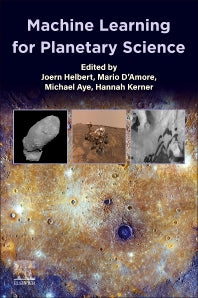
Machine Learning for Planetary Science
Introduces machine learning into the research workflow for planetary scientists, leveraging machine learning methods to enhance understanding of planetary data
Joern Helbert (Edited by), Mario D'Amore (Edited by), Michael Aye (Edited by), Hannah Kerner (Edited by)
9780128187210, Elsevier Science
Paperback, published 25 March 2022
232 pages, Approx. 110 illustrations
22.9 x 15.2 x 1.6 cm, 0.39 kg
"Machine Learning for Planetary Science presents planetary scientists with a way to introduce machine learning into the research workflow as increasingly large nonlinear datasets are acquired from planetary exploration missions. The book explores research that leverages machine-learning methods to enhance our scientific understanding of planetary data and serves as a guide for selecting the right methods and tools for solving a variety of everyday problems in planetary science using machine learning. Illustrating ways to employ machine learning in practice with case studies, the book is clearly organized into four parts to provide thorough context and easy navigation. The book covers a range of issues, from data analysis on the ground to data analysis onboard a spacecraft, and from prioritization of novel or interesting observations to enhanced missions planning. This book is therefore a key resource for planetary scientists working in data analysis, missions planning, and scientific observation." --Lunar and Planetary Institutte
Machine Learning for Planetary Science presents planetary scientists with a way to introduce machine learning into the research workflow as increasingly large nonlinear datasets are acquired from planetary exploration missions. The book explores research that leverages machine learning methods to enhance our scientific understanding of planetary data and serves as a guide for selecting the right methods and tools for solving a variety of everyday problems in planetary science using machine learning. Illustrating ways to employ machine learning in practice with case studies, the book is clearly organized into four parts to provide thorough context and easy navigation. The book covers a range of issues, from data analysis on the ground to data analysis onboard a spacecraft, and from prioritization of novel or interesting observations to enhanced missions planning. This book is therefore a key resource for planetary scientists working in data analysis, missions planning, and scientific observation.
Part I: Introduction to Machine Learning 1. Types of ML methods (supervised, unsupervised, semi-supervised; classification, regression) 2. Dealing with small labeled datasets (semi-supervised learning, active learning) 3. Selecting a methodology and evaluation metrics 4. Interpreting and explaining model behavior 5. Hyperparameter optimization and training neural networks Part II: Methods of machine learning 6. The new and unique challenges of planetary missions 7. Data acquisition (PDS nodes, etc.) and Data types, projections, processing, units, etc. Part III: Useful tools for machine learning projects in planetary science 8. The Python Spectral Analysis Tool (PySAT): A Powerful, Flexible, Preprocessing and Machine Learning Library and Interface 9. Getting data from the PDS, pre-processing, and labeling it Part IV: Case studies 10. Enhancing Spatial Resolution of Remotely Sensed Imagery Using Deep Learning and/or Data Restoration 11. Surface mapping via unsupervised learning and clustering of Mercury’s Visible–Near-Infrared reflectance spectra 12. Mapping Saturn using deep learning 13. Artificial Intelligence for Planetary Data Analytics - Computer Vision to Boost Detection and Analysis of Jupiter's White Ovals in Images Acquired by the Jiram Spectrometer
Subject Areas: Information technology: general issues [UB], Space science [TTD], Geophysics [PHVG], Theoretical & mathematical astronomy [PGC]