Freshly Printed - allow 7 days lead
Couldn't load pickup availability
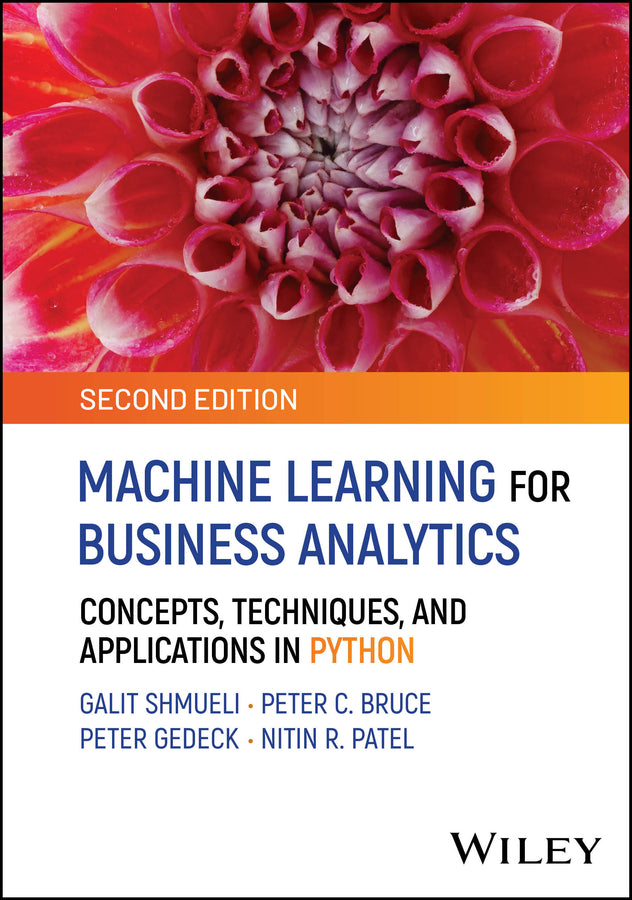
Machine Learning for Business Analytics
Concepts, Techniques, and Applications in Python
Galit Shmueli (Author), Peter C. Bruce (Author), Peter Gedeck (Author), Nitin R. Patel (Author)
9781394286799, Wiley
Hardback, published 13 May 2025
720 pages
25.2 x 17.8 x 3.8 cm, 1.588 kg
Machine Learning for Business Analytics: Concepts, Techniques, and Applications in Python is a comprehensive introduction to and an overview of the methods that underlie modern AI. This best-selling textbook covers both statistical and machine learning (AI) algorithms for prediction, classification, visualization, dimension reduction, rule mining, recommendations, clustering, text mining, experimentation, network analytics and generative AI. Along with hands-on exercises and real-life case studies, it also discusses managerial and ethical issues for responsible use of machine learning techniques. This is the second Python edition of Machine Learning for Business Analytics. This edition also includes: This textbook is an ideal resource for upper-level undergraduate and graduate level courses in AI, data science, predictive analytics, and business analytics. It is also an excellent reference for analysts, researchers, and data science practitioners working with quantitative data in management, finance, marketing, operations management, information systems, computer science, and information technology.
Foreword by Gareth James xxi Part I Preliminaries Chapter 1 Introduction 3 Chapter 2 Overview of the Machine Learning Process 17 Part II Data Exploration and Dimension Reduction Chapter 3 Data Visualization 61 Chapter 4 Dimension Reduction 101 Part III Performance Evaluation Chapter 5 Evaluating Predictive Performance 129 Part IV Prediction and Classification Methods Chapter 6 Multiple Linear Regression 167 Chapter 7 k-Nearest Neighbors (k-NN) 193 Chapter 8 The Naive Bayes Classifier 209 Chapter 9 Classification and Regression Trees 229 Chapter 10 Logistic Regression 267 Chapter 11 Neural Nets 301 Chapter 12 Discriminant Analysis 333 Chapter 13 Generating, Comparing, and Combining Multiple Models 351 Chapter 14 Experiments, Uplift Models, and Reinforcement Learning 371 Part V Mining Relationships Among Records Chapter 15 Association Rules and Collaborative Filtering 399 Chapter 16 Cluster Analysis 433 Part VI Forecasting Time Series Chapter 17 Handling Time Series 463 Chapter 18 Regression-Based Forecasting 477 Chapter 19 Smoothing and Deep Learning Methods for Forecasting 509 Part VII Data Analytics Chapter 20 Social Network Analytics 537 Chapter 21 Text Mining 561 Chapter 22 Responsible Data Science 587 Chapter 23 Generative AI 617 Part VIII Cases Chapter 24 Cases 639 References 675
Preface to the Second Python Edition xxiii
Acknowledgments xxvii
1.1 What Is Business Analytics? 3
1.2 What Is Machine Learning? 5
1.3 Machine Learning, AI, and Related Terms 5
1.4 Big Data 7
1.5 Data Science 8
1.6 Why Are There So Many Different Methods? 8
1.7 Terminology and Notation 9
1.8 Road Maps to This Book 12
2.1 Introduction 18
2.2 Core Ideas in Machine Learning 18
2.3 The Steps in a Machine Learning Project 22
2.4 Preliminary Steps 23
2.5 Predictive Power and Overfitting 37
2.6 Building a Predictive Model 43
2.7 Using Python for Machine Learning on a Local Machine 49
2.8 Automating Machine Learning Solutions 49
2.9 Ethical Practice in Machine Learning 54
3.1 Uses of Data Visualization 62
3.2 Data Examples 64
3.3 Basic Charts: Bar Charts, Line Charts, and Scatter Plots 66
3.4 Multidimensional Visualization 75
3.5 Specialized Visualizations 90
4.1 Introduction 102
4.2 Curse of Dimensionality 102
4.3 Practical Considerations 103
4.4 Data Summaries 103
4.5 Correlation Analysis 108
4.6 Reducing the Number of Categories in Categorical Variables 109
4.7 Converting a Categorical Variable to a Numerical Variable 109
4.8 Principal Component Analysis 111
4.9 Dimension Reduction Using Regression Models 121
4.10 Dimension Reduction Using Classification and Regression Trees 121
5.1 Introduction 130
5.2 Evaluating Predictive Performance 131
5.3 Judging Classifier Performance 137
5.4 Judging Ranking Performance 150
5.5 Oversampling 156
6.1 Introduction 168
6.2 Explanatory vs. Predictive Modeling 168
6.3 Estimating the Regression Equation and Prediction 170
6.4 Variable Selection in Linear Regression 176
7.1 The k-NN Classifier (Categorical Outcome) 194
7.2 k-NN for a Numerical Outcome 203
7.3 Advantages and Shortcomings of k-NN Algorithms 205
8.1 Introduction 209
8.2 Applying the Full (Exact) Bayesian Classifier 212
8.3 Solution: Naive Bayes 213
8.4 Advantages and Shortcomings of the Naive Bayes Classifier 224
9.1 Introduction 230
9.2 Classification Trees 232
9.3 Evaluating the Performance of a Classification Tree 241
9.4 Avoiding Overfitting 246
9.5 Classification Rules from Trees 252
9.6 Classification Trees for More Than Two Classes 252
9.7 Regression Trees 253
9.8 Advantages and Weaknesses of a Tree 256
9.9 Improving Prediction: Random Forests and Boosted Trees 258
10.1 Introduction 268
10.2 The Logistic Regression Model 269
10.3 Example: Acceptance of Personal Loan 272
10.4 Evaluating Classification Performance 277
10.5 Variable Selection 280
10.6 Logistic Regression for Multi-Class Classification 281
10.7 Example of Complete Analysis: Predicting Delayed Flights 285
11.1 Introduction 302
11.2 Concept and Structure of a Neural Network 302
11.3 Fitting a Network to Data 303
11.4 Required User Input 316
11.5 Exploring the Relationship Between Predictors and Outcome 317
11.6 Deep Learning 318
11.7 Advantages and Weaknesses of Neural Networks 329
12.1 Introduction 334
12.2 Distance of a Record from a Class 336
12.3 Fisher's Linear Classification Functions 337
12.4 Classification Performance of Discriminant Analysis 341
12.5 Prior Probabilities 342
12.6 Unequal Misclassification Costs 342
12.7 Classifying More Than Two Classes 344
12.8 Advantages and Weaknesses 347
13.1 Ensembles 352
13.2 Automated Machine Learning (AutoML) 359
13.3 Explaining Model Predictions 365
13.4 Summary 366
14.1 A/B Testing 372
14.2 Uplift (Persuasion) Modeling 377
14.3 Reinforcement Learning 384
14.4 Summary 393
15.1 Association Rules 400
15.2 Collaborative Filtering 413
15.3 Summary 427
16.1 Introduction 434
16.2 Measuring Distance Between Two Records 437
16.3 Measuring Distance Between Two Clusters 443
16.4 Hierarchical (Agglomerative) Clustering 445
16.5 Non-Hierarchical Clustering: The k-Means Algorithm 453
17.1 Introduction 464
17.2 Descriptive vs. Predictive Modeling 465
17.3 Popular Forecasting Methods in Business 465
17.4 Time Series Components 466
17.5 Data Partitioning and Performance Evaluation 470
18.1 A Model with Trend 478
18.2 A Model with Seasonality 484
18.3 A Model with Trend and Seasonality 486
18.4 Autocorrelation and ARIMA Models 488
19.1 Smoothing Methods: Introduction 510
19.2 Moving Average 510
19.3 Simple Exponential Smoothing 515
19.4 Advanced Exponential Smoothing 518
19.5 Deep Learning for Forecasting 521
20.1 Introduction 538
20.2 Directed vs. Undirected Networks 538
20.3 Visualizing and Analyzing Networks 539
20.4 Social Data Metrics and Taxonomy 544
20.5 Using Network Metrics in Prediction and Classification 550
20.6 Business Uses of Social Network Analysis 556
20.7 Summary 557
21.1 Introduction 562
21.2 The Tabular Representation of Text 562
21.3 Bag-of-Words vs. Meaning Extraction at Document Level 563
21.4 Preprocessing the Text 564
21.5 Implementing Machine Learning Methods 573
21.6 Example: Online Discussions on Autos and Electronics 573
21.7 Deep Learning Approaches 577
21.8 Example: Sentiment Analysis of Movie Reviews 578
21.9 Summary 581
22.1 Introduction 588
22.2 Unintentional Harm 589
22.3 Legal Considerations 591
22.4 Principles of Responsible Data Science 592
22.5 A Responsible Data Science Framework 595
22.6 Documentation Tools 599
22.7 Example: Applying the RDS Framework to the COMPAS Example 603
22.8 Summary 613
23.1 The Transformative Power of Generative AI 617
23.2 What is Generative AI? 619
23.3 Data and Infrastructure Requirements 621
23.4 Adapting Models for Specific Purposes 623
23.5 Prompt Engineering 624
23.6 Uses of Generative AI 625
23.7 Caveats and Concerns 629
23.8 Summary 631
24.1 Charles Book Club 639
24.2 German Credit 646
24.3 Tayko Software Cataloger 651
24.4 Political Persuasion 655
24.5 Taxi Cancellations 659
24.6 Segmenting Consumers of Bath Soap 661
24.7 Direct-Mail Fundraising 665
24.8 Catalog Cross-Selling 668
24.9 Time-Series Case: Forecasting Public Transportation Demand 670
24.10 Loan Approval 672
Index 677
Subject Areas: Mathematics [PB]