Freshly Printed - allow 10 days lead
Couldn't load pickup availability
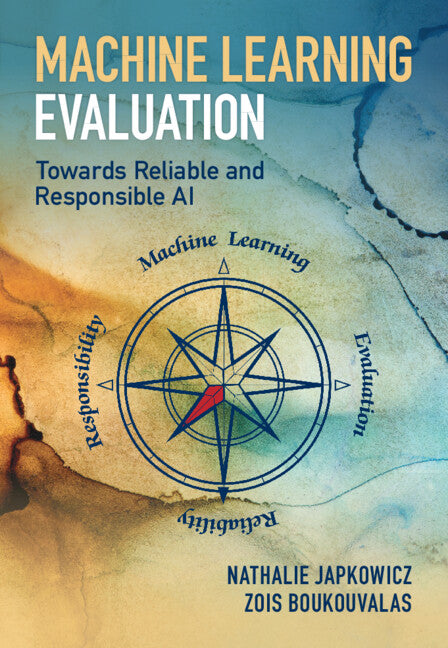
Machine Learning Evaluation
Towards Reliable and Responsible AI
A practical guide to robust performance evaluation methods machine learning models for modern industrial-strength applications.
Nathalie Japkowicz (Author), Zois Boukouvalas (Author)
9781316518861, Cambridge University Press
Hardback, published 21 November 2024
426 pages
25 x 17.5 x 2.8 cm, 0.86 kg
'I recommend this book for students and instructors of machine learning, both traditional and deep. The authors state: 'The purpose of this book is to present a concise, yet complete, intuitive, yet formal, presentation of machine learning evaluation.' In this important and useful book, they succeed on all counts.' Creed Jones, Computing Reviews
As machine learning applications gain widespread adoption and integration in a variety of applications, including safety and mission-critical systems, the need for robust evaluation methods grows more urgent. This book compiles scattered information on the topic from research papers and blogs to provide a centralized resource that is accessible to students, practitioners, and researchers across the sciences. The book examines meaningful metrics for diverse types of learning paradigms and applications, unbiased estimation methods, rigorous statistical analysis, fair training sets, and meaningful explainability, all of which are essential to building robust and reliable machine learning products. In addition to standard classification, the book discusses unsupervised learning, regression, image segmentation, and anomaly detection. The book also covers topics such as industry-strength evaluation, fairness, and responsible AI. Implementations using Python and scikit-learn are available on the book's website.
Part I. Preliminary Considerations: 1. Introduction
2. Statistics overview
3. Machine learning preliminaries
4. Traditional machine learning evaluation
Part II. Evaluation for Classification: 5. Metrics
6. Re-sampling
7. Statistical analysis
Part III. Evaluation for Other Settings: 8. Supervised settings other than simple classification
9. Unsupervised learning
Part IV. Evaluation from a Practical Perspective: 10. Industrial-strength evaluation
11. Responsible machine learning
12. Conclusion
Appendices: A. Statistical tables
B. Advanced topics in classification metrics
References
Index.
Subject Areas: Pattern recognition [UYQP]