Freshly Printed - allow 7 days lead
Couldn't load pickup availability
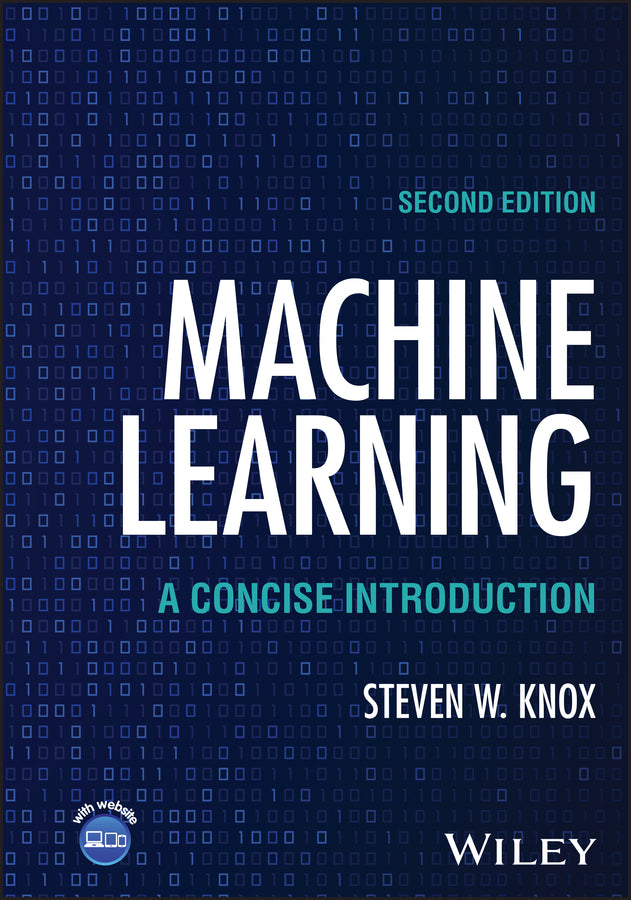
Machine Learning
A Concise Introduction
Steven W. Knox (Author)
9781394325252, Wiley
Hardback, published 28 January 2026
432 pages
25.7 x 18 x 2.5 cm, 0.975 kg
New edition of a PROSE award finalist title on core concepts for machine learning, updated with the latest developments in the field, now with Python and R source code side-by-side Machine Learning is a comprehensive text on the core concepts, approaches, and applications of machine learning. It presents fundamental ideas, terminology, and techniques for solving applied problems in classification, regression, clustering, density estimation, and dimension reduction. New content for this edition includes chapter expansions which provide further computational and algorithmic insights to improve reader understanding. This edition also revises several chapters to account for developments since the prior edition. In this book, the design principles behind the techniques are emphasized, including the bias-variance trade-off and its influence on the design of ensemble methods, enabling readers to solve applied problems more efficiently and effectively. This book also includes methods for optimization, risk estimation, model selection, and dealing with biased data samples and software limitations — essential elements of most applied projects. Written by an expert in the field, this important resource: A volume in the popular Wiley Series in Probability and Statistics, Machine Learning offers the practical information needed for an understanding of the methods and application of machine learning for advanced undergraduate and beginner graduate students, data science and machine learning practitioners, and other technical professionals in adjacent fields.
Preface xi Organization — How to Use This Book xii Acknowledgments xiv About the Companion Website xiv 1 Introduction – Examples from Real Life 1 2 The Problem of Learning 3 2.1 Domain 3 2.2 Range 4 2.3 Data 4 2.4 Loss 5 2.5 Risk 8 2.6 The Reality of the Unknown Function 12 2.7 Training and Selection of Models 12 2.8 Purposes of Learning 14 2.9 Notation 14 3 Regression 15 3.1 General Framework 16 3.2 Loss 17 3.3 Estimating the Model Parameters 17 3.4 Properties of Fitted Values 19 3.5 Estimating the Variance 22 3.6 A Normality Assumption 23 3.7 Computation 25 3.8 Categorical Features 26 3.9 Feature Expansions, Interactions, and Transformations 28 3.10 Penalized Regression: Model Transformation for Risk Reduction 31 3.11 Variations in Linear Regression 37 3.12 Nonlinear Regression 39 3.13 Nonparametric Regression 42 4 Classification 45 4.1 The Bayes Classifier 46 4.2 Introduction to Classifiers 47 4.3 Mitigating Biases in Software, Biases in Data, and Zero Probabilities 49 4.3.1 Mitigating Biases in Software by Adjusting Loss and Prior Probabilities 50 4.3.2 Mitigating Biases in Data by Adjusting Loss or Prior Probabilities 51 4.3.3 Mitigating Effects of Zero-One Probability Estimates 52 4.4 Class Boundaries 53 4.5 A Running Example 54 4.6 Likelihood Methods 55 4.6.1 Quadratic Discriminant Analysis 56 4.6.2 Linear Discriminant Analysis 58 4.6.3 Gaussian Mixture Models 60 4.6.4 Kernel Density Estimation 61 4.6.5 Histograms 65 4.6.6 The Naive Bayes Classifier 68 4.7 Prototype Methods 69 4.7.1 k-Nearest-Neighbor 69 4.7.2 Condensed k-Nearest-Neighbor 72 4.7.3 Nearest-Cluster 73 4.7.4 Learning Vector Quantization 73 4.8 Logistic Regression 76 4.8.1 The Logistic Regression Model 76 4.8.2 Adjusting the Marginal or Prior Distribution of Classes 79 4.8.3 Class Boundaries, Hyperplanes, and Geometry 81 4.9 Neural Networks 81 4.9.1 Activation Functions 81 4.9.2 Neurons 82 4.9.3 Single-Hidden-Layer Neural Networks 84 4.9.4 Multi-Hidden-Layer Neural Networks 90 4.9.5 Adjusting the Marginal or Prior Distribution of Classes 91 4.9.6 Logistic Regression and Zero-Hidden-Layer Neural Networks 91 4.10 Classification Trees 93 4.10.1 Classification of Data by Leaves (Terminal Nodes) 93 4.10.2 Impurity of Nodes and Trees 94 4.10.3 Growing Trees 95 4.10.4 Pruning Trees 98 4.10.5 Regression Trees 99 4.11 Support Vector Machines 100 4.11.1 A Geometric Definition of “Good” 100 4.11.2 Support Vector Machine Classifiers for Linearly Separable Data 101 4.11.3 The Central Role of Inner Products 103 4.11.4 Support Vector Machine Classifiers for Data Not Linearly Separable 104 4.11.5 Slack Variables as Hinge Loss 105 4.11.6 Multiple Classes, General Loss, and Non-uniform Class Prior 107 4.11.7 Approximation of the Bayes Classifier 109 4.11.8 Inner Products via Kernel Functions 110 4.12 Postscript: Example Problem Revisited 119 5 Bias-Variance Trade-Off 121 5.1 Squared-Error Loss 121 5.2 General Loss 125 6 Combining Classifiers 131 6.1 Ensembles 131 6.2 Ensemble Design 136 6.3 Bootstrap Aggregation (Bagging) 138 6.4 Random Forests 141 6.5 Boosting and Arcing 142 6.6 Classification by Regression Ensemble 147 6.7 Gradient Boosting 151 6.8 Stacking and Mixture of Experts 156 6.9 Postscript: Example Problem Revisited 160 7 Risk Estimation and Model Selection 163 7.1 Risk Estimation via Training Data 164 7.2 Risk Estimation via Validation or Test Data 164 7.2.1 Training, Validation, and Test Data Sets 164 7.2.2 Training, Validation, and Test Estimates of Risk 165 7.2.3 Application – Precision of Validation and Test Estimates of Risk 166 7.2.4 Application – Comparing a Model’s Risk to a Target Value 166 7.2.5 Application – Comparing the Difference of Models’ Risks to a Target Value 168 7.3 Cross-Validation 169 7.4 Improvements on Cross-Validation 171 7.5 Out-of-Bag Risk Estimation 172 7.6 Akaike’s Information Criterion 173 7.7 Schwartz’s Bayesian Information Criterion 174 7.8 Rissanen’s Minimum Description Length Criterion 175 7.9 R 2 and Adjusted R 2 175 7.10 Stepwise Model Selection 177 7.11 Occam’s Razor 177 7.12 Size of Validation and Test Data Sets 178 7.12.1 Measures of Performance for Hypothesis Tests About Risk 178 7.12.2 Size of Training, Validation, and Test Data Sets 178 7.12.3 Example Construction of Training, Validation, and Test Data Sets 180 7.12.4 Example Use of Training and Validation Data Sets 183 7.12.5 Example Use of Test Data Sets 186 8 Consistency 187 8.1 Convergence of Sequences of Random Variables 187 8.2 Consistency for Parameter Estimation 188 8.3 Consistency for Prediction 188 8.4 There Are Consistent and Universally Consistent Classifiers 189 8.5 Convergence to Asymptopia Is Not Uniform and May Be Slow 191 9 Clustering 193 9.1 Gaussian Mixture Models 194 9.2 k-Means 194 9.3 Clustering by Mode-Hunting in a Density Estimate 195 9.4 Using Classifiers to Cluster 196 9.5 Dissimilarity 196 9.6 k-Medoids 197 9.7 k-Modes and k-Prototypes 197 9.8 Agglomerative Hierarchical Clustering 198 9.9 Divisive Hierarchical Clustering 199 9.10 How Many Clusters Are There? Interpretation of Clustering 200 9.11 An Impossibility Theorem 201 10 Optimization 203 10.1 Quasi-Newton Methods 204 10.1.1 The Newton–Raphson Method for Finding Zeros 204 10.1.2 The Newton–Raphson Method for Optimization 205 10.1.3 Gradient Descent 205 10.1.4 The Broyden–Fletcher–Goldfarb–Shanno Algorithm 205 10.1.5 Modifications to Quasi-Newton Methods 206 10.2 The Nelder–Mead Algorithm 207 10.3 Simulated Annealing 207 10.4 Genetic Algorithms 209 10.5 Particle Swarm Optimization 210 10.6 General Remarks on Optimization 211 10.6.1 Imperfectly Known Objective Functions 211 10.6.2 Objective Functions That Are Sums 212 10.6.3 Optimization from Multiple Starting Points 212 10.7 Solving Least-Squares Problems via Quasi-Newton Methods 213 10.8 Gradient Computation for Neural Networks via Backpropagation 214 10.9 Handling Missing Data via the Expectation-Maximization Algorithm 219 10.9.1 The General Algorithm 219 10.9.2 EM Climbs the Marginal Likelihood of the Observations 220 10.9.3 Example – Fitting a Gaussian Mixture Model via EM 222 10.9.4 Example – The Expectation Step 223 10.9.5 Example – The Maximization Step 224 10.10 Fitting Support Vector Machines via Sequential Minimal Optimization 224 10.10.1 Primal and Dual Forms of the Linear SVM Optimization Problem 225 10.10.2 Slater’s Condition and the Karush–Kuhn–Tucker Conditions 226 10.10.3 Generalization to Kernel Support Vector Machines 228 10.10.4 Computation of the Intercept 229 10.10.5 Solving the Dual Problem via Sequential Minimal Optimization 229 10.10.6 Step 1 – Choosing a Pair of Coordinates to Optimize 230 10.10.7 Step 2 – Constrained Optimization of a Pair of Coordinates 231 11 High-Dimensional Data 235 11.1 The Curse of Dimensionality 236 11.2 Two Running Examples 242 11.2.1 Example 1: Equilateral Simplex 242 11.2.2 Example 2: Text 242 11.3 Reducing Dimension While Preserving Information 243 11.3.1 The Geometry of Means and Covariances of Real Features 245 11.3.2 Principal Component Analysis 246 11.3.3 Working in “Dissimilarity Space” 248 11.3.4 Linear Multidimensional Scaling 248 11.3.5 The Singular Value Decomposition and Low-Rank Approximation 250 11.3.6 Stress-Minimizing Multidimensional Scaling 252 11.3.7 Projection Pursuit 252 11.3.8 Feature Selection 253 11.3.9 Clustering 254 11.3.10 Manifold Learning 254 11.3.11 Autoencoders 257 11.4 Model Regularization 261 11.4.1 Duality and the Geometry of Parameter Penalization 262 11.4.2 Parameter Penalization as Prior Information 263 12 Communication with Clients 267 12.1 Binary Classification and Hypothesis Testing 267 12.2 Terminology for Binary Decisions 269 12.3 Receiver Operating Characteristic (ROC) Curves 271 12.4 One-Dimensional Measures of Performance 273 12.5 Confusion Matrices 276 12.6 Pairwise Model Comparison 277 12.7 Multiple Testing 277 12.7.1 Control the Familywise Error 278 12.7.2 Control the False Discovery Rate 278 12.8 Expert Systems 279 12.9 Ethics in Machine Learning 280 12.9.1 Philosophical Foundations 280 12.9.2 Clear Goals 281 12.9.3 Good Practice 281 12.9.4 Machine Learning Might Not Be the Answer, and That’s OK 282 12.9.5 Documentation 282 13 Current Challenges in Machine Learning 283 13.1 Streaming Data 283 13.2 Distributed Data 283 13.3 Semi-Supervised Learning 283 13.4 Active Learning 284 13.5 Feature Construction via Deep Neural Networks 284 13.6 Transfer Learning 284 13.7 Interpretability and Protection of Complex Models 285 14 R and Python Source Code 287 14.1 Author’s Biases 288 14.2 Packages and Code 288 14.3 The Running Example (Section 4.5) 289 14.4 The Bayes Classifier (Section 4.1) 292 14.5 Quadratic Discriminant Analysis (Section 4.6.1) 294 14.6 Linear Discriminant Analysis (Section 4.6.2) 296 14.7 Gaussian Mixture Models (Section 4.6.3) 297 14.8 Kernel Density Estimation (Section 4.6.4) 300 14.9 Histograms (Section 4.6.5) 304 14.10 The Naive Bayes Classifier (Section 4.6.6) 309 14.11 k-Nearest-Neighbor (Section 4.7.1) 312 14.12 Learning Vector Quantization (Section 4.7.4) 314 14.13 Logistic Regression (Section 4.8) 317 14.14 Neural Networks (Section 4.9) 319 14.15 Classification Trees (Section 4.10) 324 14.16 Support Vector Machines (Section 4.11) 332 14.17 Bootstrap Aggregation (Bagging) (Section 6.3) 341 14.18 Random Forests (Section 6.4) 343 14.19 Boosting by Reweighting (Section 6.5) 345 14.20 Boosting by Sampling (Arcing) (Section 6.5) 346 14.21 Gradient Boosted Trees (Section 6.7) 347 Appendix-A: List of Symbols 351 Appendix-B: The Condition Number of a Matrix with Respect to a Norm 353 Appendix-C: Converting Between Normal Parameters and Level-Curve Ellipsoids 357 Appendix-D: The Geometry of Linear Functions and Linear Classifiers 359 Appendix-E: Training Data and Fitted Parameters 367 Appendix-F: Solutions to Selected Exercises 371 Bibliography 399 Index 413
Subject Areas: Mathematics [PB]