Freshly Printed - allow 8 days lead
Couldn't load pickup availability
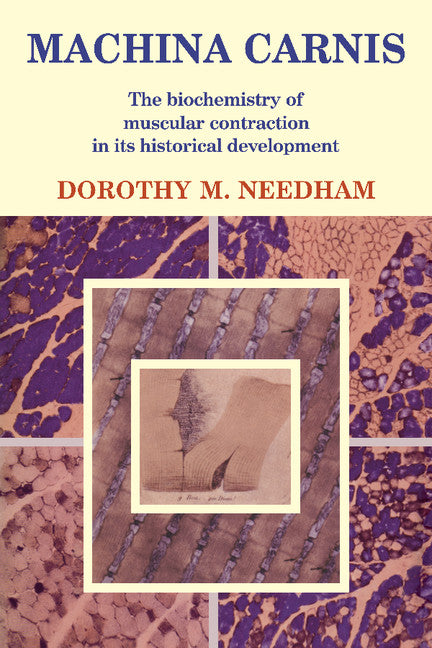
Machina Carnis
The Biochemistry of Muscular Contraction in its Historical Development
This book is an account of the centuries of experiment and speculation that have led to our understanding of how muscles work.
Dorothy M. Needham (Author)
9780521112673, Cambridge University Press
Paperback, published 4 June 2009
820 pages
22.9 x 15.2 x 4.1 cm, 1.9 kg
Originally published in 1971, this is an account of the centuries of experiment and speculation that have led to our understanding of how muscles work. The book traces all the developments in the field since 1600 and devotes special attention to the breakthroughs made in the last century. It considers the nature of the muscle machine and its fuel, as well as the intricate regulation of energy supply under different conditions. It also examines the very varied kinds of muscle and the effects of some diseases on their structure and function. Finally it shows how the energy metabolism first elucidated for the mechanical work of muscle has been found to explain most of the other kinds of work done by cells, as in light production, secretion, ionic transport and electrical discharge. The biochemistry of muscle, carbohydrate metabolism and phosphorylations was the author's chosen field of research for over forty years.
Preface
1. Bringing muscles into focus: the first two millennia
2. Muscle metabolism after the Chemical Revolution
3. the relationship between mechanical events, heat production and metabolism
4. The influence of brewing science on the study of muscle glycolysis
5. The discovery of phosphagen and adenosinetriphosphate
6. Adenosinetriphosphate as fuel and as phosphate-carrier
7. Early studies of msucle structure and theories of contraction
8. Interaction of actomyosin and ATP
9. Some theories of contraction mechanism
10. On myosin, actin and tropomyoson
11. The sliding mechanism
12. How does the sliding mechanism work?
13. Excitation, excitation-contraction coupling and relaxation
14. Happenings in intact muscle
15. Rigor and the chemical
changes responsible for its onset
16. Respiration
17. Oxidative phosphorylation
18. The regulation of carbohydrate metabolism for energy supply to the muscle machine
19. A comparative study of the striated muscle of vertebrates
20. Enzymic and other effects of denervation, cross-innervation and repeated stimulation
21. some aspects of muscle disease
22. Contraction in muscles of invertebrates
23. Vertebrate smooth muscle
24. Energy provision and contactile proteins in non-muscular functions
References.
Subject Areas: Biology, life sciences [PS]