Freshly Printed - allow 8 days lead
Couldn't load pickup availability
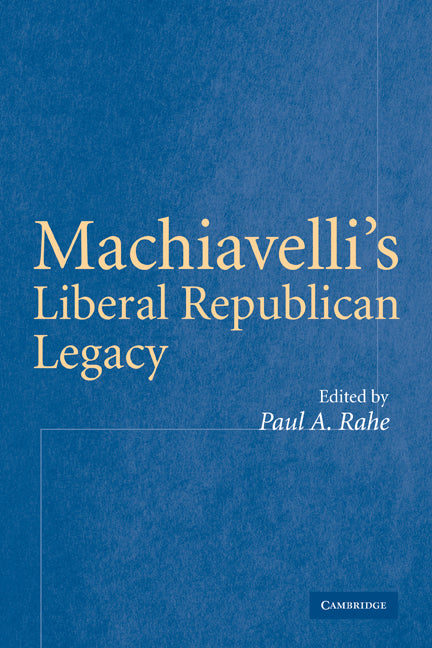
Machiavelli's Liberal Republican Legacy
This book examines the significance of Machiavelli's political thinking for the development of modern republicanism.
Paul A. Rahe (Edited by)
9780521153539, Cambridge University Press
Paperback, published 10 June 2010
390 pages
23 x 15.2 x 2.4 cm, 0.5 kg
"The authors provide a valuable synopsis of some major, as well as some lesser-known, political thinkers in the Anglo-American tradition. I recommend this book to all those with an interest in the history of Anglo-American political thought, as well as those looking to transcend the standard liberal republican dichotomies in contemporary interpretations of the American founding."
Canadian Journal of History
The significance of Machiavelli's political thinking for the development of modern republicanism is a matter of great controversy. In this volume, a distinguished team of political theorists and historians reassess the evidence, examining the character of Machiavelli's own republicanism and charting his influence on Marchamont Nedham, James Harrington, John Locke, Algernon Sidney, John Trenchard, Thomas Gordon, David Hume, the Baron de Montesquieu, Benjamin Franklin, George Washington, John Adams, Thomas Jefferson, James Madison, and Alexander Hamilton. This work argues that while Machiavelli himself was not liberal, he did set the stage for the emergence of liberal republicanism in England. By the exponents of commercial society he provided the foundations for a moderation of commonwealth ideology and exercised considerable, if circumscribed, influence on the statesmen who founded the American Republic. Machiavelli's Liberal Republican Legacy will be of great interest to political theorists, early modern historians, and students of the American political tradition.
List of contributors
Acknowledgements
Abbreviations and brief titles
Introduction: Machiavelli's liberal republican legacy Paul A. Rahe
Prologue: Machiavelli's rapacious republicanism Markus Fischer
Part I. The English Commonwealthmen: 1. Machiavelli in the English revolution Paul A. Rahe
2. The philosophy of liberty: Locke's Machiavellian teaching Margaret Michelle Barnes Smith
3. Muted and manifest English Machiavellism: the reconciliation of Machiavellian republicanism with liberalism in Sidney's Discourses Concerning Government and Trenchard's and Gordon's Cato's Letters Vickie B. Sullivan
Part II. The Moderate Enlightenment: 4. Getting our bearings: Machiavelli and Hume John W. Danford
5. The Machiavellian spirit of Montesquieu's liberal republic Paul Carrese
6. Benjamin Franklin's 'Machiavellian' civic virtue Steven Forde
Part III. The American Founding: 7. The American prince? George Washington's anti-Machiavellian moment Matthew Spalding
8. John Adam's Machiavellian moment C. Bradley Thompson
9. Thomas Jefferson's Machiavellian political science Paul A. Rahe
10. James Madison's princes and peoples Gary Rosen
11. Was Alexander Hamilton a Machiavellian statesman? Karl-Friedrich Walling
Index.
Subject Areas: Political science & theory [JPA], History of ideas [JFCX]