Freshly Printed - allow 3 days lead
Couldn't load pickup availability
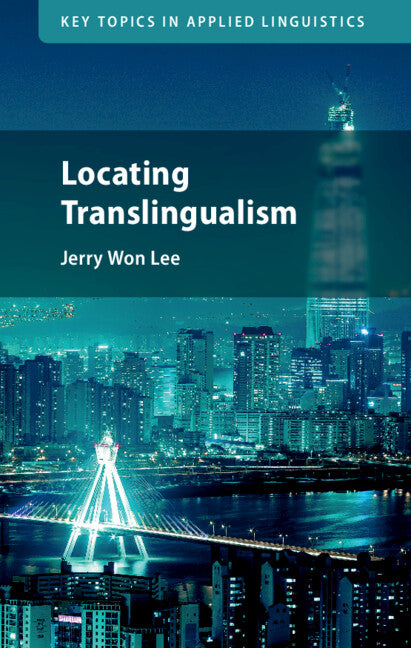
Locating Translingualism
This book questions what culture is and what it is assumed to 'look like' in the context of globalization.
Jerry Won Lee (Author)
9781009108690, Cambridge University Press
Paperback / softback, published 28 April 2022
218 pages
21.5 x 14 x 1.3 cm, 0.29 kg
'What happens when we study culture from a transnational perspective? How will it shape our understanding of language? Through fascinating analyses of how 'Koreanness' is constructed across time and space, Jerry Won Lee's new book snatches us away from familiar places where culture supposedly resides, and takes us on a mind-expanding journey where we discover that meaning in language is resignified and recalibrated anew in every circuit of encounter.' Joseph Sung-Yul Park, National University of Singapore
Encounters involving different cultures and languages are increasingly the norm in the era of globalization. While considerable attention has been paid to how languages and cultures transform in the era of globalization, their characteristic features prior to transformation are frequently taken for granted. This pioneering book argues that globalization offers an unprecedented opportunity to revisit fundamental assumptions about what distinguishes languages and cultures from each other in the first place. It takes the case of global Korea, showing how the notion of 'culture' is both represented but also reinvented in public space, with examples from numerous sites across Korea and Koreatowns around the world. It is not merely about locating spaces where translingualism happens but also about exploring the various ways in which linguistic and cultural difference come to be located via translingualism. It will appeal to anyone interested in the globalization of language and culture.
List of Figures
Acknowledgements
A Note on the Text
Introduction
I.1. Language, Culture, and Caterpillars from a Bird's Eye View
I.2. Translingualism in/as Space
I.3. Cosmopolitanism and Cultural Difference
I.4. Semiotic Precarity
I.5. Book Overview
1. Translingualism and the Locations of Culture
1.1. Where is Culture?
1.2. Translingual Inversion
1.3. National Imaginaries and Representational Precarity
1.4. National Imaginaries and the Logic of Seriality
1.5. Translingual Inversion and the Location of National Imaginaries
2. Locating Global Korea
2.1. Korea as Ice Hockey Team
2.2. Korea as Nation as Discourse
2.3. Global Korea
Or, Korea Globally
2.4. Locating the Locations of Global Korea
2.5. Conclusion: Korea via the Globe
3. Encountering the Unfamiliar: Languaging Culture
3.1. Unfamiliar Language
3.2. Korea as Language?
3.3. Weird Language
3.4. Weird Translations
3.5. Weird Transliterations
3.6. Weird Translingualizations
3.7. Conclusion: Negotiable Language, Locatable Language
4. Visible Nation: Scaling Culture
4.1. Street Fighter II as Nations and Nationalism
4.2. Scale as Culture
4.3. Culture as Color: How Red Became Korean
4.4. Koryo as Chronotope of Korea
4.5. Culture as Sample Image: Disputed Territory as Caricatural Geography
4.6. Conclusion: Is It Possible to See the Nation?
5. Semiotic Excess: Tracing Culture
5.1. Cool Story, Hanguk
5.2. Unexpectedness and the Traces of Culture
5.3. KoreatownTM
5.4. X-Modernity
5.5. Global Korea as Toiletscape
5.6. Conclusion: Korea as Trace
Conclusion: More Locations of Culture
C.1. Modular Imaginaries
Or, Citizen Sociolinguistics as a Human Right
C.2. Departing Thoughts
References
Index.
Subject Areas: Social & cultural anthropology, ethnography [JHMC], Historical & comparative linguistics [CFF], Sociolinguistics [CFB], Language: history & general works [CBX]