Freshly Printed - allow 10 days lead
Couldn't load pickup availability
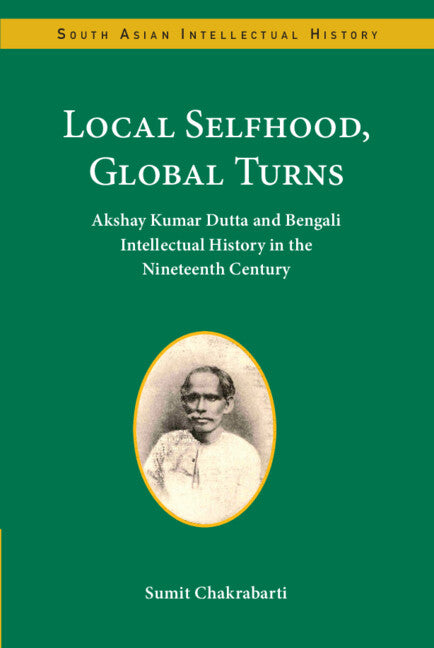
Local Selfhood, Global Turns
Akshay Kumar Dutta and Bengali Intellectual History in the Nineteenth Century
Locates Akshay Kumar Datta as one of the foundational figures of intellectual refashioning in nineteenth-century Bengal.
Sumit Chakrabarti (Author)
9781009339827, Cambridge University Press
Hardback, published 27 June 2024
272 pages
22.9 x 15.2 x 1.9 cm, 0.507 kg
'Not quite a reformer like Rammohun nor yet a nationalist like Bankim, Akshay Kumar Dutta was the epitome of an era in transition, dedicated to the vernacularization of political, natural, and moral philosophy in mid-nineteenth century Bengal. Sumit Chakrabarti situates Akshay within the global ebb and flow of scientific rationality, liberal politics, and romantic culturalism, illuminating Akshay's vision of India as informed by, but not beholden to, European modernity. It may have been Akshay's path to tutor rather than to command, but even so his embrace of methodical reason was fuelled by dreams of possibility. Appreciating his quietly consequential legacy requires both erudition and affection, and Chakrabarti writes with both.' Brian A. Hatcher, author of Hinduism Before Reform
The book examines the works of Akshay Kumar Dutta (1820–1886), who can be seen as ideologically inhabiting the cusp between religion and rationalism – the two most crucial avenues of debate and discussion in the public sphere in nineteenth-century Bengal. While nineteenth-century Bengal has been an important discourse within South Asian history, major figures of reform such as Rammohun Roy, Debendranath Tagore, Iswarchandra Vidyasagar, or Keshub Chunder Sen have generally been the focus. The book attempts to rescue Dutta from the clutches of academic amnesia, and to locate him as one of the foundational figures of intellectual refashioning among the common albeit educated public in nineteenth-century Bengal.
Introduction
1. The Discontents of Eclecticism: The Milieu of Akshay Kumar Dutta
2. The New World of Science: Akshay Dutta as the 'Science Worker'
3. The Tattwabodhini Period: The Conflicting Contours of Self-Fashioning or Towards a Global History?
4. Reconstructing Bengali Selfhood: The Conception of Dharma in Akshay and Bankim
5. On the Question of the Public Sphere: Civic Life, Polity, Dissent, and an Affective Engagement with the Janasamaj
6. Imagining Bharatvarsha: Identity, History, Nationhood
Conclusion and Further Thoughts
Index.
Subject Areas: Asian history [HBJF]