Freshly Printed - allow 10 days lead
Couldn't load pickup availability
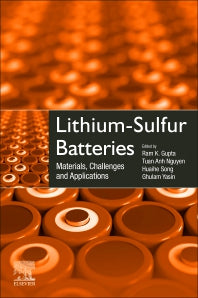
Lithium-Sulfur Batteries
Materials, Challenges and Applications
Emphasizes novel materials, architectural concepts, and methods to improve the performance of lithium-sulfur batteries
Ram Gupta (Edited by), Tuan Anh Nguyen (Edited by), Huaihe Song (Edited by), Ghulam Yasin (Edited by)
9780323919340
Paperback / softback, published 5 March 2022
708 pages, 200 illustrations (100 in full color)
22.9 x 15.2 x 4.3 cm, 1.16 kg
Lithium-Sulfur Batteries: Materials, Challenges, and Applications presents the advantages of lithium-sulfur batteries, such as high theoretical capacity, low cost, and stability, while also addressing some of the existing challenges. Some of the challenges are low electrical conductivity, the possible reaction of sulfur with lithium to form a soluble lithium salt, the formation of the dendrimer, large volume variation of cathode materials during the electrochemical reaction, and shuttle behavior of highly soluble intermediate polysulfides in the electrolyte. This book provides some possible solutions to these issues through novel architecture, using composite materials, doping to improve low conductivity, etc., as well as emphasizing novel materials, architectural concepts, and methods to improve the performance of lithium-sulfur batteries.
PART 1: BASIC PRINCIPLES 1. Introduction to electrochemical energy storage technologies 2. A recent development in Li-S batteries 3. Chemistry and operation of Li–S batteries 4. High-performance Lithium-Sulfur batteries: Role of nanotechnology and nanoengineering 5. Mathematical modeling of Li–S batteries 6. Nanomaterials for advanced Li-S batteries: An introduction 7. Nanocomposites for binder-free Li-S electrodes 8. Separators for Li–S batteries 9. Progress and Perspective of separators towards high-performance lithium sulfur batteries 10. Electrolytes for Li–S batteries PART 2: NANOMATERIALS AND NANOSTRUCTURES FOR SULFUR CATHODES 11. Porous carbon-sulfur composite cathodes 12. Recent advancement on nanocomposites of carbon / sulfur electrodes for lithium sulfur (Li-S) batteries 13. Advances in nanomaterials for sulfurized carbon cathodes 14. Graphene-sulfur composite cathodes 15. Nanocomposites of graphene-sulfur as cathode materials and separators for Li-S batteries 16. Graphene-sulfur nanohybrids for cathodes in Li-S batteries 17. Metal-organic framework-based cathode materials in Li-S batteries 18. MXene-based sulfur composite cathodes 19. Polymeric nanocomposites for Li-S batteries 20. Design of nanostructured sulfur cathodes for high-performance lithium-sulfur battery 21. Nanostructured additives and binders for sulfur cathodes PART 3: LITHIUM METAL ANODES: MATERIALS AND TECHNOLOGY 22. Metallic Li anode: An introduction 23. Advanced carbon-based nanostructured framework for Li anodes 24. Carbon-based anode materials for lithium-ion batteries PART 4: APPLICATIONS AND FUTURE PERSPECTIVES 25. Li-S batteries for marine applications 26. Two-dimensional layered materials for flexible electronics and batteries 27. Sustainability in Li–S batteries 28. Recyclability and recycling technologies for lithium-sulfur batteries 29. Recyclability, circular economy, and environmental aspects of Lithium-sulfur batteries
Subject Areas: Materials science [TGM]