Special Order - allow 2+ weeks lead
Couldn't load pickup availability
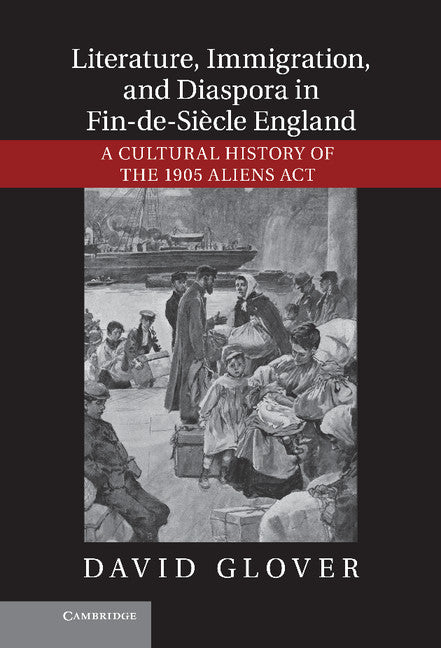
Literature, Immigration, and Diaspora in Fin-de-Siècle England
A Cultural History of the 1905 Aliens Act
Provides an in-depth history of the 1905 Aliens Act, from its late Victorian cultural origins to its early-twentieth-century aftermath.
David Glover (Author)
9781107022812, Cambridge University Press
Hardback, published 24 September 2012
240 pages, 2 b/w illus.
22.9 x 15.2 x 1.7 cm, 0.52 kg
'A painstakingly researched study.' The Times Literary Supplement
The 1905 Aliens Act was the first modern law to restrict immigration to British shores. In this book, David Glover asks how it was possible for Britain, a nation that had prided itself on offering asylum to refugees, to pass such legislation. Tracing the ways that the legal notion of the 'alien' became a national-racist epithet indistinguishable from the figure of 'the Jew', Glover argues that the literary and popular entertainments of fin de siècle Britain perpetuated a culture of xenophobia. Reconstructing the complex socio-political field known as 'the alien question', Glover examines the work of George Eliot, Israel Zangwill, Rudyard Kipling and Joseph Conrad, together with forgotten writers like Margaret Harkness, Edgar Wallace and James Blyth. By linking them to the beliefs and ideologies that circulated via newspapers, periodicals, political meetings, Royal Commissions, patriotic melodramas and social surveys, Glover sheds new light on dilemmas about nationality, borders and citizenship.
List of illustrations
Acknowledgments
Introduction
1. Messianic neutrality: George Eliot and the politics of national identity
2. Palaces and sweatshops: East End fictions and East End politics
3. Counterpublics of anti-Semitism
4. Writing the 1905 Aliens Act
5. Restriction and its discontents
Afterword
Notes
Index.
Subject Areas: Early modern history: c 1450/1500 to c 1700 [HBLH], British & Irish history [HBJD1], Literary studies: from c 1900 - [DSBH]