Freshly Printed - allow 10 days lead
Couldn't load pickup availability
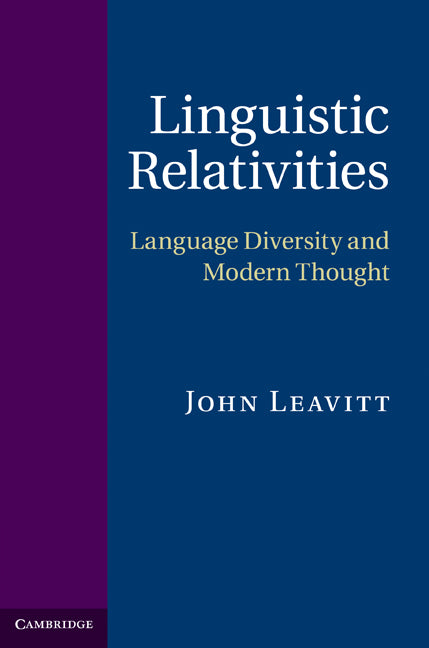
Linguistic Relativities
Language Diversity and Modern Thought
Does your language influence your thought and world view? This book is a history of responses to this question since the 1500s.
John Leavitt (Author)
9780521767828, Cambridge University Press
Hardback, published 23 December 2010
256 pages
22.9 x 15 x 2 cm, 0.51 kg
'I wholeheartedly recommend this book to anyone interested in the relation between language and thought, linguistic diversity and to everyone who is seriously concerned with the development of central issues in the field of linguistics.' Katerina Stathi, Languages in Contrast
There are more than six thousand human languages, each one unique. For the last five hundred years, people have argued about how important language differences are. This book traces that history and shows how language differences have generally been treated either as of no importance or as all-important, depending on broader approaches taken to human life and knowledge. It was only in the twentieth century, in the work of Franz Boas and his students, that an attempt was made to engage seriously with the reality of language specificities. Since the 1950s, this work has been largely presented as yet another claim that language differences are all-important by cognitive scientists and philosophers who believe that such differences are of no importance. This book seeks to correct this misrepresentation and point to the new directions taken by the Boasians, directions now being recovered in the most recent work in psychology and linguistics.
Introduction
1. A passage to modernity
2. One reason, one world, many monads
3. The world at war with reason: Britain and France in the eighteenth century
4. Multiplicity and the Romantic explosion
5. Essences and universals through the nineteenth century
6. Boas and the linguistic multiverse
7. Linguistic relativity: Sapir, Lee, and Whorf
8. The other side of the mirror: a twentieth-century essentialism
9. The rise of cognition and the repression of languages
10. The return of the repressed
Conclusion.
Subject Areas: Cognition & cognitive psychology [JMR], Social & cultural anthropology, ethnography [JHMC], Sociolinguistics [CFB], Philosophy of language [CFA]