Freshly Printed - allow 7 days lead
Couldn't load pickup availability
Linguistic Anthropology
A Reader
"Another stellar contribution from a leading linguistic anthropologist who is also the field's foremost anthologist and textbook author. The updated readings, editorial framing, and appended study-questions are excellent throughout." "This new volume reflects the vibrancy of work in linguistic anthropology, and will be an indispensable teaching resource for language and culture courses of many different kinds." "This revised edition of Duranti's text provides an indispensable introduction to the vibrant field of linguisic anthopology. Duranti provides conceptual vocabulary and ethnographic exemplars for the complex multiplicity of language as a social activity, ranging from relatively isolated small-scale societies to speech communities within contemporary American society." "Framed by an excellent historical introduction, Duranti's reader provides students and scholars alike with a sophisticated yet accessible introduction to the range of topics and approaches that make up modern linguistic anthropology. The readings, linked by concise and thoughtful introductions, include a judicious mix of classic articles and new research. This collection should provide a definitive vision for linguistic anthropology for a long time to come." "Very well organized and selected, and thus an excellent teaching resource, this reader provides perspective on the coherence of linguistic anthropology as a field. It can also be flexibly tailored to bring a linguistic approach to most arenas of topical interest to contemporary anthropological research."
–Alan Rumsey, Australian National University
–Penelope Brown, Max Plank Institute for Psycholinguistics
–Regna Darnell, University of Western Ontario
–Bradd Shore, Emory University
–George Marcus, Rice University
Alessandro Duranti (Edited by)
9781405126335, Wiley
Hardback, published 17 April 2009
536 pages
25.4 x 17.8 x 3.6 cm, 1.052 kg
"Alessandro Duranti has succeeded in compiling an excellent reader that many instructors and students will find useful as an introduction to key works in linguistic anthropology. Leaders in the theory and practice of contemporary linguistic anthropology are well represented, and all of the articles are excellent; indeed, most are recognized as contemporary "classics" in the field. This reader is an excellent addition to the growing library of readers in linguistic anthropology and a valuable new resource for both students and teachers." (Current Anthropology [from 1st edition]) "Many of the articles included...are examples of highly innovative scholarly work on issues of language related to culture. It provides an excellent (and long overdue) discussion of terminology, American lingustic anthropology's development within Cultural Anthropology, its subsequent drift away from anthropology towards an independent discipline increasingly focused on theoretical anthropologists in the late 1960s, and its reestablishment as a subfield of anthropology in the 1980s-90s. As a textbook this reader makes a very useful teaching aid, as a source book it provides valuable insights into the discipline of linguistic anthropology." (Linguist List)
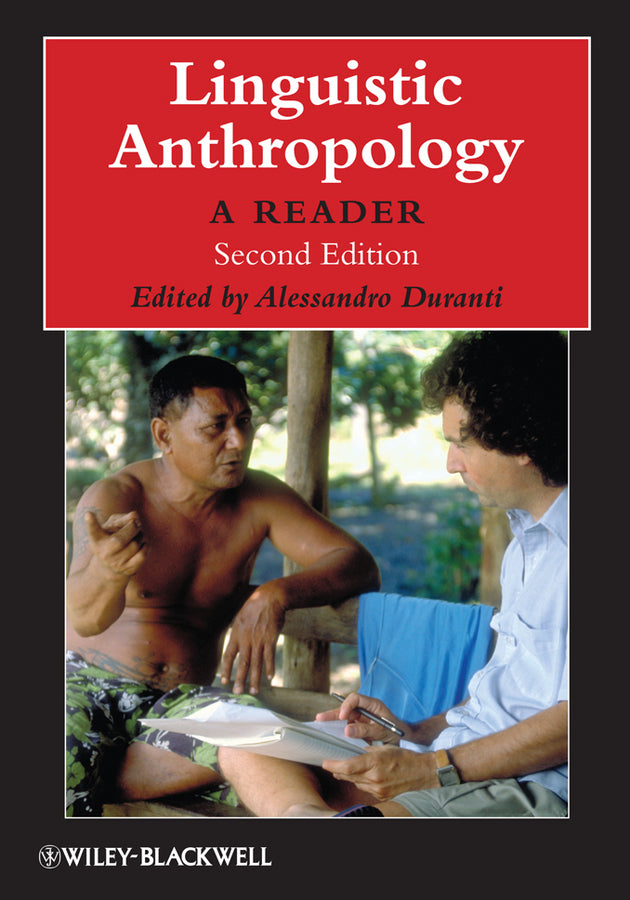
Linguistic Anthropology: A Reader is a comprehensive collection of the best work that has been published in this exciting and growing area of anthropology, and is organized to provide a guide to key issues in the study of language as a cultural resource and speaking as a cultural practice.
Acknowledgments to the Second Edition. Preface to the Second Edition. Linguistic Anthropology: History, Ideas, and Issues (Alessandro Duranti). Part I: Ideal and Real Speech Communities. Introduction. 1 The Speech Community (John J. Gumperz). 2 The African-American Speech Community: Reality and Sociolinguists (Marcyliena Morgan). 3 The Social Circulation of Media Discourse and the Mediation of Communities (Debra Spitulnik). 4 Communication of Respect in Interethnic Service Encounters (Benjamin Bailey). 5 The Idealised Native Speaker, Reified Ethnicities, and Classroom Realities (Constant Leung, Roxy Harris, and Ben Rampton). Part II: The Performance of Language: Events, Genres, and Narratives. Introduction. 6 Ways of Speaking (Dell Hymes). 7 Formality and Informality in Communicative Events (Judith T. Irvine) 8 Universal and Culture-Specific Properties of Greetings (Alessandro Duranti). 9 Genre, Intertextuality, and Social Power (Charles L. Briggs and Richard Bauman). 10 Narrating the Political Self in a Campaign for US Congress (Alessandro Duranti). 11 Hip Hop Nation Language (H. Samy Alim). Part III: Language Socialization and Literacy Practices. Introduction. 12 Language Acquisition and Socialization: Three Developmental Stories and Their Implications (Elinor Ochs and Bambi B. Schieffelin). 13 Participant Structures and Communicative Competence: Warm Springs Children in Community and Classroom (Susan U. Philips). 14 What No Bedtime Story Means: Narrative Skills at Home and School (Shirley Brice Heath). 15 Creating Social Identities through Doctrina Narratives (Patricia Baquedano-López). Part IV: The Power of Language. Introduction. 16 Arizona Tewa Kiva Speech as a Manifestation of a Dominant Language Ideology (Paul V. Kroskrity). 17 Language Ideology and Linguistic Differentiation (Judith T. Irvine and Susan Gal). 18 The “Father Knows Best” Dynamic in Dinnertime Narratives (Elinor Ochs and Carolyn Taylor). 19 Professional Vision (Charles Goodwin). 20 Language, Race, and White Public Space (Jane H. Hill). 21 No (Don Kulick). Index.
Subject Areas: Archaeology [HD]