Freshly Printed - allow 7 days lead
Couldn't load pickup availability
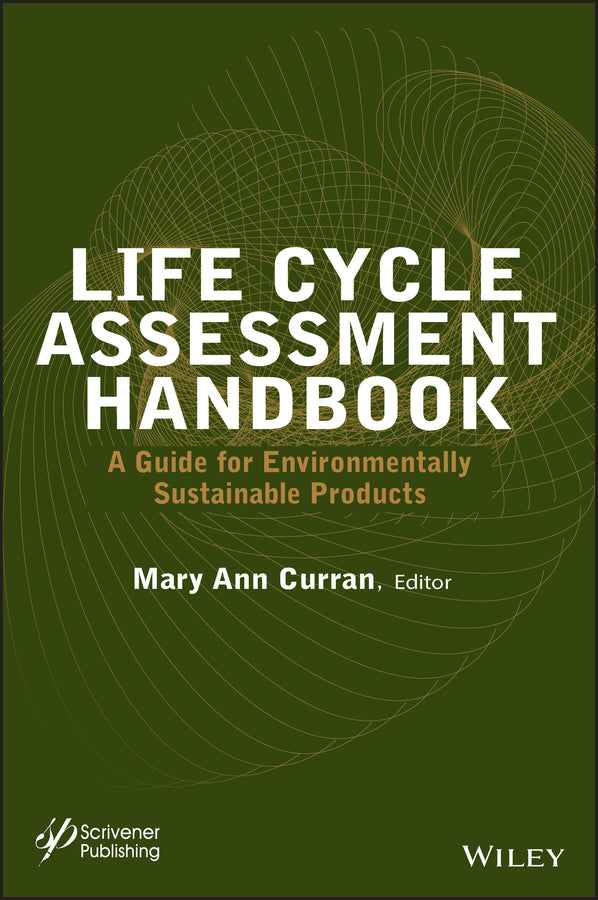
Life Cycle Assessment Handbook
A Guide for Environmentally Sustainable Products
Mary Ann Curran (Edited by)
9781118099728, Wiley
Hardback, published 2 November 2012
640 pages
26.2 x 18.5 x 3.9 cm, 1.247 kg
“My overall impression of the book is that of a rich source of LCA information offered by a large group of LCA experts in their respective fields.” (Int J Life Cycle Assess, 13 March 2014)
The first book of its kind, the Life Cycle Assessment Handbook: A Guide for Environmentally Sustainable Products will become an invaluable resource for environmentally progressive manufacturers and suppliers, product and process designers, executives and managers, and government officials who want to learn about this essential component of environmental sustainability. As the last several decades have seen a dramatic rise in the application of Life Cycle Assessment (LCA) in decision making, the interest in the life cycle concept as an environmental management and sustainability tool continues to grow. The LCA Handbook offers a look at the role that life cycle information, in the hands of companies, governments, and consumers, may have in improving the environmental performance of products and technologies. It concisely and clearly presents the various aspects of LCA in order to help the reader better understand the subject. The content of the book was designed with a certain flow in mind. After a high-level overview to describe current views and state-of-the-practice of LCA, it presents chapters that address specific LCA methodological issues including creating life cycle inventory, life cycle impact assessment, and capturing eco-systems services. These are followed by example applications of LCA in the agri-food industry; sustainable supply chain management; solid waste management; mining and mineral extraction; forest products; buildings; product innovation; and sustainable chemistry and engineering. The international success of the sustainability paradigm needs the participation of many stakeholders, including citizens, corporations, academia, and NGOs. The handbook links LCA and responsible decision making and how the life cycle concept is a critical element in environmental sustainability. It covers issues such as building capacity in developing countries and emerging economies so that they are more capable of harnessing the potential in LCA for sustainable development. Governments play a very important role with the leverage they have through procurement, regulation, international treaties, tax incentives, public outreach, and other policy tools. This compilation points to the clear trend for incorporating life cycle information into the design and development processes for products and policies, just as quality and safety concerns are now addressed throughout product design and development.
Preface xix 1 Environmental Life Cycle Assessment: Background and Perspective 1 Part 1: Methodology and Current State of LCA Practice 2 An Overview of the Life Cycle Assessment Method - Past, Present, and Future 15 3. Life Cycle Inventory Modeling in Practice 43 4 Life Cycle Impact Assessment 67 5 Sourcing Life Cycle Inventory Data 105 6 Software for Life Cycle Assessment 143 Part 2: LCA Applications 7 Modeling the Agri-Food Industry with Life Cycle Assessment 159 Exergy Analysis and its Connection to Life Cycle Assessment 185 Accounting for Ecosystem Goods and Services in Life Cycle Assessment and Process Design 217 A Case Study of the Practice of Sustainable Supply Chain Management 233 Life Cycle Assessment and End of Life Materials Management 249 Application of LCA in Mining and Minerals Processing – Current Programs and Noticeable Gaps 267 Sustainable Preservative-Treated Forest Products, Their Life Cycle Environmental Impacts, and End of Life Management Opportunities: A Case Study 291 Buildings, Systems Thinking, and Life Cycle Assessment 311 Life Cycle Assessment in Product Innovation 329 Life Cycle Assessment as a Tool in Food Waste Reduction and Packaging Optimization - Packaging Innovation and Optimization in a Life Cycle Perspective 345 Integration of LCA and Life-Cycle Thinking within the Themes of Sustainable Chemistry & Engineering 369 Part 3: LCA Supports Decision Making and Sustainability 18 How to Approach the Assessment? 391 19 Integration of MCDA Tools in Valuation of Comparative Life Cycle Assessment 413 Social Life Cycle Assessment: A Technique Providing a New Wealth of Information to Inform Sustainability-Related Decision Making 433 Life Cycle Sustainability Analysis 453 22 Environmental Product Claims and Life Cycle Assessment 475 Part 4: Operationalizing LCA 23 Building Capacity for Life Cycle Assessment in Developing Countries 545 Environmental Accountability: A New Paradigm for World Trade is Emerging 563 Life Cycle Knowledge Informs Greener Products 585 Index 597
Gjalt Huppes and Mary Ann Curran
Reinout Heijungs and Jeroen B. Guinee
Beverly Sauer
Manuele Margni and Mary Ann Curran
Mary Ann Curran
Andreas Ctroth
Bruno Notarnicola, Giuseppe Tassielli and Pietro A. Renzulli
Marc A. Rosen, Ibrahim Dincer and Ahmet Ozbilen
Erin F. Landers, Robert A. Urban and Bhavtk R. Baksht
Annie Wetsbrod and Larry Loftus
Keith A. Weitz
Dr. Mary Stewart, Dr. Peter Holt and Mr. Rob Rouwette
Christopher A. Bolin
Joel Ann Todd
Nuno Da Silva
Ole Jörgen Haussen, Hanne Moller, Erik Svanes and Vibeke Schakenda
Shawn Hunter, Richard Helling and Dawn Shiang
Jose Potting, Shabbtr Gheewala, Sebastten Bonnet and Joost van Buuren
Valenttna Prado, Kristen Rogers and Thomas P. Seager PhD
Catherine Benott Norris
Alessandra Zamagni, Jeroen Guinee, Reinout Hetjungs and Paolo Masoni
Martha J. Stevenson and Wesley W. Ingwersen
Prof. Toolseeram Ramjeawon
Ann K. Ngo
James Fava
Subject Areas: Chemistry [PN]