Freshly Printed - allow 10 days lead
Couldn't load pickup availability
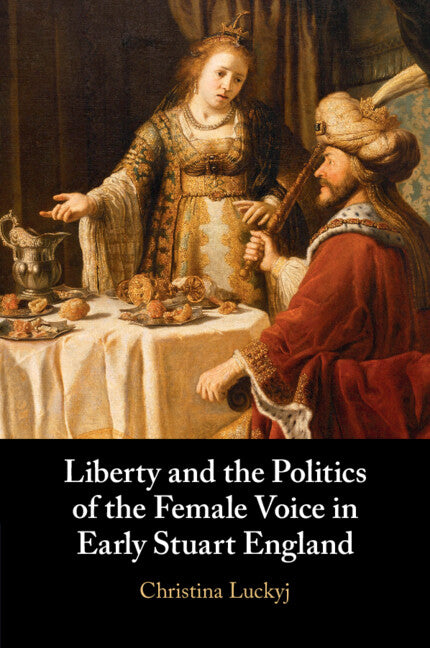
Liberty and the Politics of the Female Voice in Early Stuart England
This study illuminates the female voice as a means of signalling resistance to tyranny in early Stuart literature and discourse.
Christina Luckyj (Author)
9781108949521, Cambridge University Press
Paperback / softback, published 29 February 2024
292 pages
22.8 x 14.9 x 1.5 cm, 0.43 kg
'Christina Luckyj's Liberty and the Politics of the Female Voice in Early Stuart England compels readers to revise their assumptions about the female voice as merely interested in domestic forms of conduct and marital conflict. She opens their work to a wider political interest, which is related to that more private but no less political agenda. The personal is political, as we know, and Luckyj brings this home to her readers in new and exciting ways.' Cristina León Alfar, Renaissance and Reformation / Renaissance et Réforme
The female voice was deployed by male and female authors alike to signal emerging discourses of religious and political liberty in early Stuart England. Christina Luckyj's important new study focuses critical attention on writing in multiple genres to show how, in the coded rhetoric of seventeenth-century religious politics, the wife's conscience in resisting tyranny represents the rights of the subject, and the bride's militant voice in the Song of Songs champions Christ's independent jurisdiction. Revealing this gendered system of representation through close analysis of writings by Elizabeth Cary, Aemilia Lanyer, Rachel Speght, Mary Wroth and Anne Southwell, Luckyj illuminates the dangers of essentializing female voices and restricting them to domestic space. Through their connections with parliament, with factional courtiers, or with dissident religious figures, major women writers occupied a powerful oppositional stance in relation to early Stuart monarchs and crafted a radical new politics of the female voice.
1. The politics of the female voice
2. Conscience and desire
3. Elizabeth Cary and the 'publike-good'
4. 'Not Sparing Kings:' Aemilia Lanyer
5. Rachel Speght and the 'Criticall Reader'
6. Mary Wroth and the politics of liberty
7. 'Yokefellow, or Slave:' Anne Southwell.
Subject Areas: Gender studies, gender groups [JFSJ], Literary studies: c 1500 to c 1800 [DSBD], Literature: history & criticism [DS]