Freshly Printed - allow 10 days lead
Couldn't load pickup availability
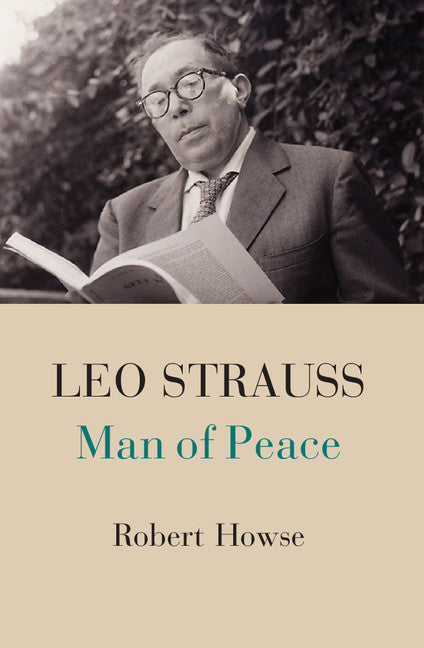
Leo Strauss
Man of Peace
This book analyzes Leo Strauss's writings on political violence, considering also what he taught in the classroom on this subject.
Robert Howse (Author)
9781107074996, Cambridge University Press
Hardback, published 8 September 2014
196 pages
23.5 x 15.7 x 1.8 cm, 0.45 kg
'In his own contribution to this discussion, Howse seeks to understand Strauss as Strauss understood himself (to borrow a venerable Straussian precept). He is thus preoccupied with Strauss' writings, lectures and letters. Like previous authors plowing these fields, however, Howse is also interested to some extent in the phenomenon of the Strauss 'cult' - that is, the fervent, often-cliquish group of Straussian teachers and students whose devotion to the Straussian 'project' has now stretched over several generations.' Gary Rosen, The National Interest
Leo Strauss is known to many people as a thinker of the right, who inspired hawkish views on national security and perhaps advocated war without limits. Moving beyond gossip and innuendo about Strauss's followers and the Bush administration, this book provides the first comprehensive analysis of Strauss's writings on political violence, considering also what he taught in the classroom on this subject. In stark contrast to popular perception, Strauss emerges as a man of peace, favorably disposed to international law and skeptical of imperialism - a critic of radical ideologies who warns of the dangers to free thought and civil society when intellectuals ally themselves with movements that advocate violence. Robert Howse provides new readings of Strauss's confrontation with fascist/Nazi jurist Carl Schmitt, his debate with Alexandre Kojève about philosophy and tyranny, and his works on Machiavelli and Thucydides and examines Strauss's lectures on Kant's Perpetual Peace and Grotius's Rights of War and Peace.
1. Introduction: reopening the case of Leo Strauss
2. Warrior morality and the fate of civilization: Strauss's encounter with Carl Schmitt and German nihilism
3. Legitimacy and legality, thinking and ruling in the closed society and the world state: the Strauss/Kojève debate
4. Strauss's Machiavelli: fallen angel and theoretical man
5. Thucydides versus Machiavelli: a moral-political horizon of war and law
6. Justice and progress: Strauss's assessment of modern international law
7. Conclusion.
Subject Areas: Political science & theory [JPA], Politics & government [JP]