Freshly Printed - allow 10 days lead
Couldn't load pickup availability
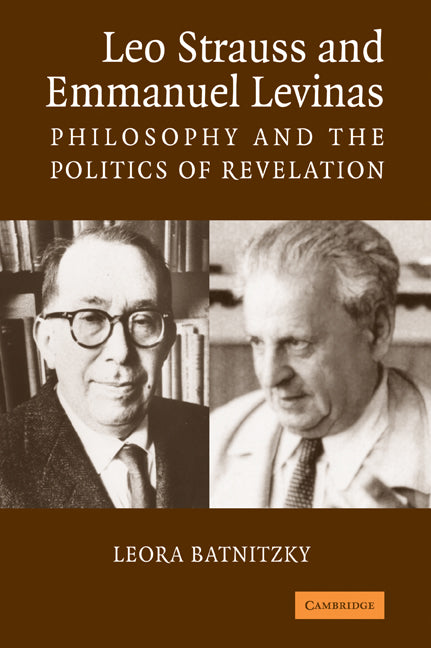
Leo Strauss and Emmanuel Levinas
Philosophy and the Politics of Revelation
In this 2006 book, Leora Batnitzky brings together two seemingly incongruous contemporaries, demonstrating that their projects had many parallels.
Leora Batnitzky (Author)
9780521679350, Cambridge University Press
Paperback / softback, published 23 August 2007
304 pages
22.8 x 15.2 x 1.7 cm, 0.461 kg
'Leo Strauss and Emmanuel Levinas: Philosophy and the Politics of Revelation is an original work of engagement of these two important thinkers that takes us far beyond what most of their admirers and detractors have written about their thought. Leora Batnitzky is a critical scholar and thinker in a class by herself.' David Novak, University of Toronto
Leo Strauss and Emmanuel Levinas, two twentieth-century Jewish philosophers and two extremely provocative thinkers whose reputations have grown considerably, are rarely studied together. This is due to the disparate interests of many of their intellectual heirs. Strauss has influenced political theorists and policy makers on the right while Levinas has been championed in the humanities by different cadres associated with postmodernist thought. In Leo Strauss and Emmanuel Levinas: Philosophy and the Politics of Revelation, first published in 2006, Leora Batnitzky brings together these two seemingly incongruous contemporaries, demonstrating that they often had the same philosophical sources and their projects had many formal parallels. While such a comparison is valuable in itself for better understanding each figure, it also raises profound questions in the debate on the definitions of 'religion', suggesting ways that religion makes claims on both philosophy and politics.
Acknowledgements
List of abbreviations
Preface
Part I. Philosophy: 1. Strauss and Levinas between Athens and Jerusalem
2. Levinas's defense of modern philosophy: how Strauss might respond
Part II. Revelation: 3. 'Freedom depends upon its bondage': the shared debt to Franz Rosenzweig
4. An irrationalist rationalism: Levinas's transformation of Hermann Cohen
5. The possibility of pre-modern rationalism: Strauss's transformation of Hermann Cohen
Part III. Politics: 6. Against utopia: law and its limits
7. Zionism and the discovery of prophetic politics
8. Politics and hermeneutics: Strauss's and Levinas's retrieval of classical Jewish sources
9. Revelation and commandment
10. Concluding thoughts: progress or return?
Notes
References
Index.