Freshly Printed - allow 10 days lead
Couldn't load pickup availability
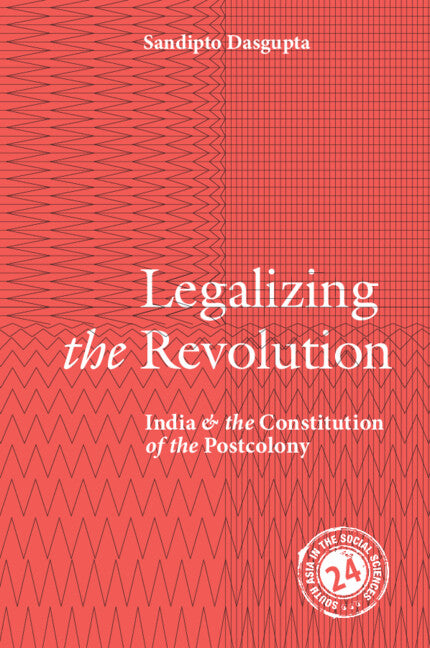
Legalizing the Revolution
India and the Constitution of the Postcolony
Theorizes the project of instituting a postcolonial order following decolonization, though an account of the Indian constitution.
Sandipto Dasgupta (Author)
9781009525244, Cambridge University Press
Paperback / softback, published 24 October 2024
280 pages
22.8 x 15 x 3 cm, 0.65 kg
'This account of the origins of the Indian constitution is nothing short of heroic, and its relevance to our global present is plain. Arrestingly, Sandipto Dasgupta lifts promotional and romanticizing frames - however appealing in the face of far-right politics today - in order to recapture the promise of postcolonial democracy without ignoring imperial legacies of constitutionalism itself and material realities that elite legalism confirmed as much as challenged. Lurking beneath contemporary appropriations that excessively centre rights and judges rather than class and parliamentarism, Dasgupta provides authentic access to the stakes of the moment - and our own.' Samuel Moyn, Yale University
Anticolonial movements of the twentieth century generated ambitious ideas of freedom. Following decolonization, the challenge was to give an institutional form to those ideas. Through an original account of India's constitution making, Legalizing the Revolution explores the promises, challenges, and contradictions of that task. In contrast to derived templates, Dasgupta theorizes the distinctively postcolonial constitution through an innovative synthesis of the history of decolonization and constitutional theory. The book traces the contentious transition from the tumult of popular anticolonial politics to the ordered calculus of postcolonial governance; and then explains how major institutions – parliament, judiciary, rights, property – were formed by that foundational tension. A major contribution to postcolonial political theory, the book excavates the unrealized futures of decolonization. At the same time, through a critical account of the making of the postcolonial constitutional order, it offers keys to understanding the present crisis of that order, including and especially in India.
Introduction: Decolonization and Constitution
Part I. Revolution without a Revolution: 1. The Anticolonial Movement
2. Transformations
Part II. Authors: 3. They, The People
4. The Constituent Administrator
Part III. Institutions: 5. Democracy and Parliamentarism
6. Rights and Repression
7. Property and Labour
8. Judiciary and Lawyers
Conclusion: The Postcolonial Afterlives of Law and Revolution
Epilogue: The Biographies of the Indian Constitution
Notes
Index.
Subject Areas: Constitution: government & the state [JPHC]