Freshly Printed - allow 8 days lead
Couldn't load pickup availability
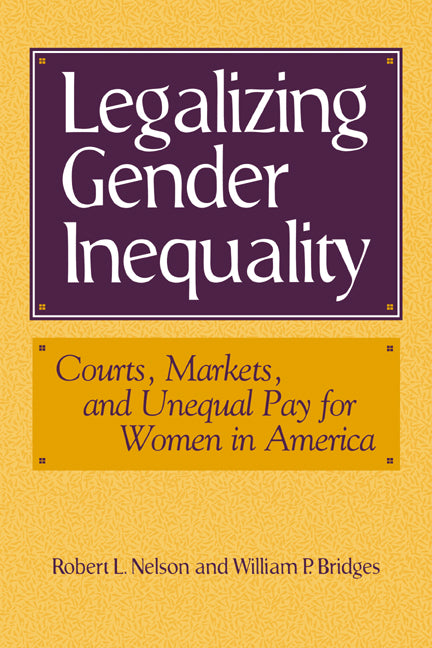
Legalizing Gender Inequality
Courts, Markets and Unequal Pay for Women in America
Legalizing Gender Inequality challenges existing theories of gender inequality within economic, sociological, and legal organization.
Robert L. Nelson (Author), William P. Bridges (Author)
9780521627504, Cambridge University Press
Paperback, published 28 May 1999
412 pages, 10 b/w illus. 35 tables
22.9 x 15.3 x 2.4 cm, 0.56 kg
"Legalizing Gender Equality is essential reading for scholars of social inequality, gender, and sociology of law. The books breaks new ground in a highly polarized debate over pay equity. The results of this compelling study testify to the importantce of mapping variations in gender inequality across different market and organizational contexts." American Journal of Sociology
Legalizing Gender Inequality challenges existing theories of gender inequality within economic, sociological, and legal organizations. The book argues that male-female earnings differentials cannot be explained adequately by market forces, principles of efficiency, or society-wide sexism. Rather it suggests that employing organizations tend to disadvantage holders of predominantly female jobs by denying them power in organizational politics and by reproducing male cultural advantages. These findings contradict major legal precedents which have argued that labor markets and not employers are the source of inequality. The authors further argue that comparable worth is an inappropriate remedy, as such an approach misdiagnoses the causes of gender inequality and often falls prey to the same organizational processes that initially generated this differential. The book argues that the courts have, by uncritically accepting the market explanation for male-female wage disparity, tended to legitimate and to legalize a crucial dimension of gender inequality in American society.
List of figures and tables
Acknowledgements
1. Law, markets, and the institutional construction of gender inequality in pay
Part I. Theory and Method: 2. Legal theories of sex-based pay discrimination
3. Toward an organizational theory of gender inequality in pay
4. Methodological approach: law cases, case studies, and critical empiricism
Part II. The Case Studies. Section A. Public Sector Organizations: 5. Paternalism and politics in a university pay system: Christensen v. State of Iowa
6. Bureaucratic politics and gender inequality in a state pay system: AFSCME v. State of Washington
Section B. Private Sector Organizations: 7. Corporate politics, rationalization, and managerial discretion: EEOC v. Sears, Roebuck & Co.
8. The financial institution as a male, profit-making club: Glass v. Coastal Bank
Part III. Conclusion: Legalizing Gender Inequality: 9. Rethinking the relationship between law, markets, and gender inequality in organizations
Appendix: court documents and case materials used in case studies
References
Index.
Subject Areas: Gender studies, gender groups [JFSJ]