Special Order - allow 2+ weeks lead
Couldn't load pickup availability
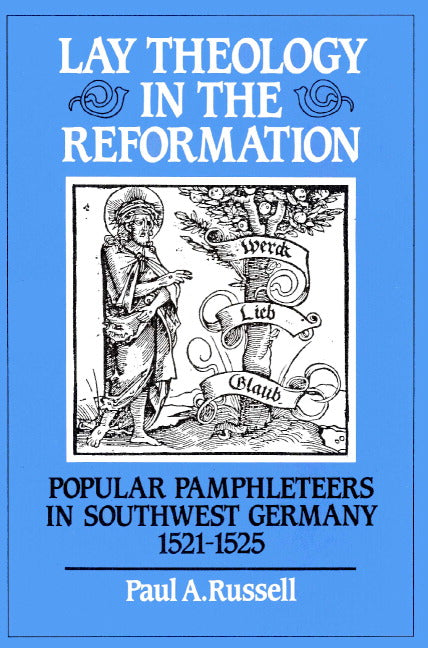
Lay Theology in the Reformation
Popular Pamphleteers in Southwest Germany 1521–1525
This book examines the coming of the Protestant Reformation from the viewpoint of eight common people.
Paul A. Russell (Author)
9780521520294, Cambridge University Press
Paperback / softback, published 20 June 2002
304 pages
22.8 x 15.4 x 2.3 cm, 0.489 kg
This book examines the coming of the Protestant Reformation from the viewpoint of eight common people, who were sufficiently disturbed by the events of 1521–5 to write treatises, letters, dialogues, and sermons, which they published. Their works are lively testimony to the interest of laypeople in the affairs of the church, and their willingness to discuss often complex theological training. These works are among the first documents of lay theology and piety, but they are also propaganda: disappointed with the Catholic clergy and with secular authorities, the authors of these pamphlets were called to prophesy, preach, and convert their readers/listeners lest Christ return soon to find his church unprepared. They demanded a new apostolate for laypeople, something the clergy had feared for centuries and something which civic authorities feared as a potential source of radical ideas.
List of illustrations
List of figures
Preface
Acknowledgements
Introduction
1. The call to prophesy: piety and discontent in the urban community of late-medieval Germany
2. Reformers and laypeople
3. Memmingen: a furrier, a preacher, and a peasants' war
4. Augsburg: a weaver, a soldier, and a radical Franciscan
5. Nuremberg: a shoemaker, a painter, and an inquisition
6. Female pamphleteers: the housewives strike back
Conclusions
Notes and abbreviations
Bibliography
Index.
Subject Areas: Early modern history: c 1450/1500 to c 1700 [HBLH], European history [HBJD]