Freshly Printed - allow 8 days lead
Couldn't load pickup availability
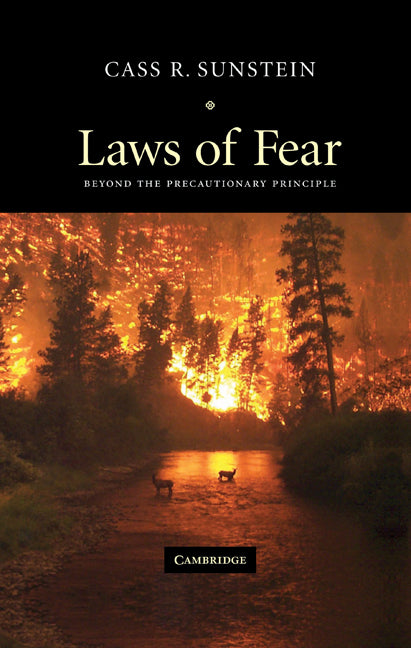
Laws of Fear
Beyond the Precautionary Principle
A major statement from one of the most influential political and legal theorists writing today.
Cass R. Sunstein (Author)
9780521848237, Cambridge University Press
Hardback, published 31 March 2005
248 pages
22.3 x 14.5 x 2 cm, 0.462 kg
'… an interesting piece for readers who are concerned about the perception of risk, hazards and the necessary policies to prevent panic in general. A book self-oriented not only to the mitigation of real-based risks but also to the academician assessment of under what circumstances the fear operates and becomes panic.' Korstanje Maximiliano, International Journal of Disaster Resilience in the Built Environment
What is the relationship between fear, danger, and the law? Cass Sunstein attacks the increasingly influential Precautionary Principle - the idea that regulators should take steps to protect against potential harms, even if causal chains are uncertain and even if we do not know that harms are likely to come to fruition. Focusing on such problems as global warming, terrorism, DDT, and genetic engineering, Professor Sunstein argues that the Precautionary Principle is incoherent. Risks exist on all sides of social situations, and precautionary steps create dangers of their own. Diverse cultures focus on very different risks, often because social influences and peer pressures accentuate some fears and reduce others. Instead of adopting the Precautionary Principle, Professor Sunstein argues for three steps: a narrow Anti-Catastrophe Principle, designed for the most serious risks; close attention to costs and benefits; and an approach called 'libertarian paternalism', designed to respect freedom of choice while also moving people in directions that will make their lives go better. He also shows how free societies can protect liberty amidst fears about terrorism and national security. Laws of Fear represents a major statement from one of the most influential political and legal theorists writing today.
Acknowledgements
Introduction
Part I. Problems: 1. Precautions and paralysis
2. Behind the precautionary principle
3. Worst case scenarios
4. Fear as wildfire
Part II. Solutions: 5. Reconstructing the precautionary principle - and managing fear
6. Costs and benefits
7. Democracy, rights, and distribution
8. Libertarian paternalism with Richard Thaler
9. Fear and liberty
A concluding note: fear and folly
Index.
Subject Areas: Jurisprudence & philosophy of law [LAB], Political science & theory [JPA], Psychology [JM], Social & political philosophy [HPS]