Freshly Printed - allow 10 days lead
Couldn't load pickup availability
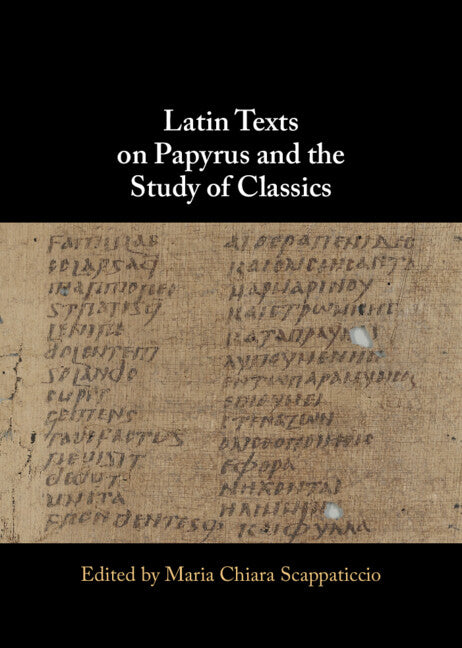
Latin Texts on Papyrus and the Study of Classics
Approaches Latin texts on papyrus from multi-disciplinary perspectives to demonstrate their potential to illuminate the field of Classics.
Maria Chiara Scappaticcio (Edited by)
9781009586597, Cambridge University Press
Hardback, published 8 January 2026
502 pages, 10 b/w illus.
24.4 x 17 x 2.7 cm, 1.095 kg
This volume gathers 25 chapters focused on Latin texts on papyrus, exploring them from multi- and cross-disciplinary perspectives. It serves as a companion to the texts published in The Corpus of Latin Texts on Papyrus (Cambridge, forthcoming). The chapters provide in-depth analyses of the chosen texts from literary, philological, linguistic, and historical perspectives, or offer methodological reflections on Latin texts on papyrus, promoting innovative approaches. They cover topics ranging from palaeography and philology to Latin literature and from ancient law to ancient and medieval history, and brilliantly demonstrate the potential of Latin texts on papyrus to inspire and illuminate the field of Classics.
Latin Texts on Papyrus: A Project, Its Corpus, and the Future of Research. I. The Literary Perspective, II. The Documentary Perspective M. C. Scappaticcio and L. C. Colella
Part I. Philological and Literary Insights: 1. The papyri of Terence and the Latin grammatical tradition F. Biville
2. Latin gnomic literature in light of P. Mich. VII 430 (= CLTP IB.20) A. S. Gitner
3. Medical or culinary recipes? On the technical prose of a first-century roll A. Garcea
4. P. Hamb. II 167 recto: drama (in prose?) C. Panayotakis
5. The Latin papyri from the Herculaneum library: new results and fresh perspectives T. Dorandi
6. Editing the Carmen de Bello Aegyptiaco for the CLTP: new results and further perspectives V. Piano
7. Virgilian Centos and Papyri Vergilianae P. Paolucci
8. 'Varus, give me back my … money!' Marginal notes on the Hadrianus S. Rocchi
Part II. Philological and Linguistic Insights: 9. From Roman Egypt to the Renaissance: the evolution of the Celtis glossary (part 1) E. Dickey
10. From Roman Egypt to the Renaissance: the evolution of the Celtis glossary (part 2) R. Ferri
11. Latin in Roman soldiers' and veterans' private documents: selected case studies A. Pezzella
12. The relevance of the Italian papyri to the study of late Latin and the emergence of the Romance vernaculars R. Sornicola
13. On the Latin–Arabic bilingual papyrus, British Library inv. 3124: the 'Italian' connection G. D'Alessio
14. Allography in Latin ostraca (Assenamat, Gigthi, Bu Njem): linguistic analysis of Paleo-Amazigh personal names and external implications A. Bernini
15. Latin ostraca from Tripolitania C. Múrcia Sanchez
Part III. Palaeographic Insights: 16. The Latin papyri and the history of writing, or about their contribution to the formation of a scientific vocabulary in palaeography T. De Robertis
17. Some reflections on the presence of accents in the Montserrat Cicero's in Catilinam ii A. Nodar
18. A Survey on abbreviating (and punctuation) signs in Latin documentary papyri, ostraka and tablets from Roman Africa and the East (BCE I–VII CE) G. Iovine
19. Rethinking the evidence for Latin shorthand in Late Antiquity and the Early Middle Ages A. Ghignoli
Part IV. Juridical and Historical Insights: 20. Ancient jurists and Latin papyri F. Nasti
21. The contribution of the CLTP to the study of Roman justice M. Pedone
22. Julio-Claudian procedural reforms and imperial constitutions in the light of BGU II 611 and BGU II 628 P. Buongiorno
23. Marcus Aper and the ala Apriana L. Capponi
24. Did a fiscus barbaricus ever exist? Remarks on P.Ital. 1 (AD 445–446) D. Internullo.
Subject Areas: Classical history / classical civilisation [HBLA1]