Freshly Printed - allow 10 days lead
Couldn't load pickup availability
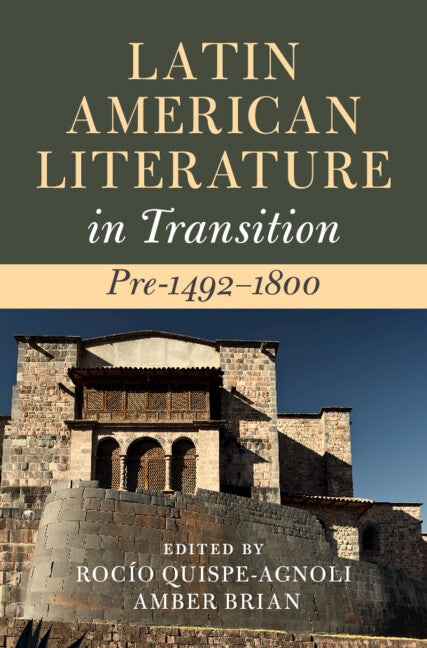
Latin American Literature in Transition Pre-1492–1800
Examines the transitions from approximately 1492-1800 that intersected and shaped the emergence of Latin America and its distinctive literary production.
Rocío Quispe-Agnoli (Edited by), Amber Brian (Edited by)
9781108838832, Cambridge University Press
Hardback, published 8 December 2022
400 pages
23.5 x 15.8 x 2.3 cm, 0.75 kg
'… this is an outstanding collective study of the epistemological, socio-political, religious and cultural transitions that have taken place in colonial Latin America as represented in its foundational cultural discourses.' Ignacio Lopez-Calvo, Bulletin of Spanish Studies
The year 1492 invokes many instances of transition in a variety of ways that intersected, overlapped, and shaped the emergence of Latin America. For the diverse Native inhabitants of the Americas as well as the people of Europe, Africa, and Asia who crossed the Atlantic and Pacific as part of the early-modern global movements, their lived experiences were defined by transitions. The Iberian territories from approximately 1492-1800 extended from what is now the US Southwest to Tierra del Fuego, and from the Iberian coasts to the Philippines and China. Built around six thematic areas that underline key processes that shaped the colonial period and its legacies – space, body, belief systems, literacies, languages, and identities – this innovative volume goes beyond the traditional European understanding of the lettered canon. It examines a range of texts including books published in Europe and the New World and manuscripts stored in repositories around the globe that represent poetry, prose, judicial proceedings, sermons, letters, grammars, and dictionaries.
Part I. Land, Space, Territory: 1. Migrations and foundations in the literature of New Spain Pablo García Loaeza
2. Defining Portuguese America: The first depictions of Brazil within the context of overseas expansion Sarissa Carneiro
3. The conquest of space in the Relación del Descubrimiento del Rio Marañon by Geronimo de Ypori (c. 1630) Yamile Silva
4. Disturbing place: Afro-Iberian herbalists interrupt imperial Cartagena de Indias Kathryn Joy McKnight
Part II. Body: 5. The Health of the Soul: Religious guidance and medical practice in early colonial Mexico Yarí Pérez Marín
6. Viceroy Valero's heart: A traveling relic, and an embodied metaphor in transit to the Indies Judith Farré Vidal
7. Humoralism and colonial subjugation: Indians and medical knowledge in the sixteenth and seventeenth centuries Germán Morong Reyes
8. Assaulted bodies: the case of two enslaved black women in the port city of Santa María de los Ángeles de Buenos Aires, 1772-1778 Mariselle Meléndez
Part III. Belief Systems: 9. The flood story in the Huarochirí Manuscript and other early colonial andean texts Soledad González Díaz
10. Idol or Martyr: Sacredness and symbol in the religiosity of the Indies Esperanza López Parada
11. Creole religiosity in colonial Mexico: Devotional cultures in transition Stephanie Kirk
12. The empire beyond Spanish America: Spanish Augustinians in the Pacific World Eva María Mehl
13. Indigenous peoples and Catholicism in eighteenth-century Mexico City Mónica Díaz
Part IV. Literacies: 14. Transcultural intertextuality in colonial Latin America Galen Brokaw
15. Becoming a book: The reproduction, falsification, and digitalization of colonial codices José Ramón Jouve-Martín
16. From print to public performance to Relaciones de fiestas: Don Quixote in viceregal festivals Eva María Valero Juan
17. Colonial Latin American bibliography and the indigenous text Clayton McCarl and Lindsay Van Tine
Part V. Languages: 18. Technologies of communication in transition: Indigenous orality and writing in colonial Mexico Kelly S. McDonough
19. A baroque arte: Horacio Carochi and the tradition of nahuatl grammars Caroline Egan
20. Acquiring a voice: the plebeians speak in early colonial Río de La Plata Loreley El Jaber
21. Knowledge in transition: Rethinking the science of sameness in Sor Juana Inés de la Cruz's New Spain Allison Margaret Bigelow
Part VI. Identities: 22. Textual figures and modalities of change: The Soldier, the Translator, the Plebeian, and the Woman Chronicler Valeria Añón
23. Diego Muñoz Camargo and the destabilization of the Relación Geográfica: adaptation and variation in the Mestizo Chronicle Héctor Costilla Martínez
24. Representing/erasing the other in colonial Brazil's eighteenth-century epic poetry Sandra Sousa.
Subject Areas: Literary studies: general [DSB]