Freshly Printed - allow 7 days lead
Couldn't load pickup availability
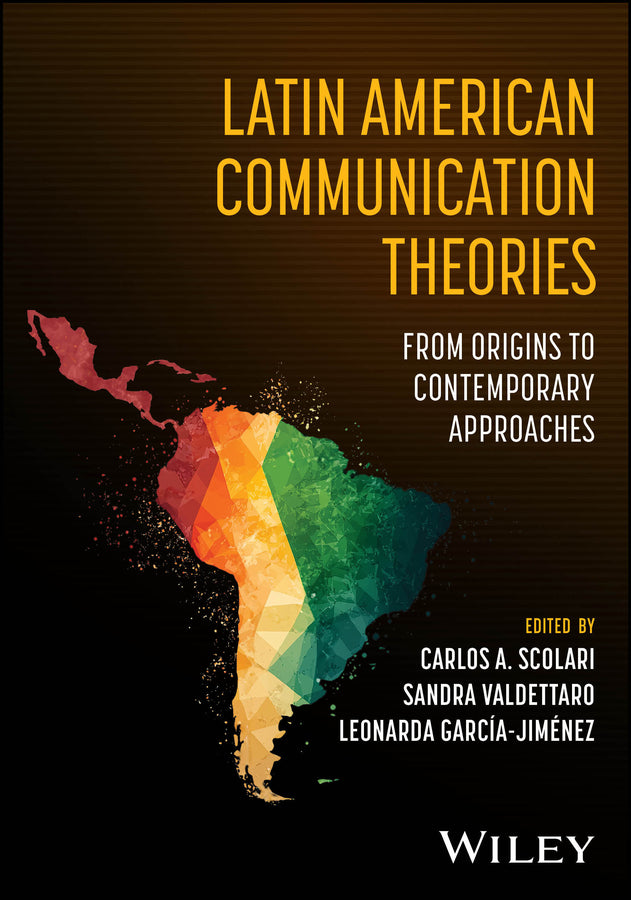
Latin American Communication Theories
From Origins to Contemporary Approaches
Carlos A. Scolari (Edited by), Sandra Valdettaro (Edited by), Leonarda García-Jiménez (Edited by)
9781394307821, Wiley
Paperback / softback, published 2 July 2026
288 pages
25.2 x 17.8 x 1.5 cm, 0.59 kg
The first English-language anthology of Latin American communication theory Latin American communication scholarship has shaped global debates on mediation, dependency, and mediatization, yet most foundational texts remain unavailable in English. Latin American Communication Theories: From the Origins to Contemporary Approaches, assembled by a team of communication scholars based at leading universities in Spain and Argentina, translates and contextualizes key writings from six decades of regional research for an international readership. The volume maps intellectual trajectories from development and dependency theories through mediation, cultural industries, popular cultures, and mediatization. Introductory and section-level editorial texts guide readers through the historical, institutional, and theoretical evolution of the field. Classic contributions appear alongside emerging voices, creating a structured overview that connects Latin American debates with contemporary global discussions in media and communication studies. Readers will also find: Designed for graduate students, doctoral researchers, and faculty in communication theory, media studies, cultural studies, and Latin American studies, this anthology provides direct access to a scholarly tradition that has remained largely outside the English-language canon while offering structured pathways through its core debates and concepts.
Introduction: Narrating Latin American Communication Theories xii Section I From Development to Culture, Via Liberation 1 Chapter 1 Democratization of Communication 3 Chapter 2 The Framework of Ideological Analysis 21 Chapter 3 Analysis of Forms: From Micro to Macro 34 Chapter 4 On Theory and Theoreticism in Communication 45 Chapter 5 Gramsci with Bourdieu: Hegemony, Consumption, and New Forms of Popular Organization 55 Chapter 6 Technological Euphoria and Discomfort in Theory 68 Chapter 7 Black Culture as Ecological Thought 87 Chapter 8 The Society of Spectators: Notes on Some Reception Theories 100 Chapter 9 Framework for the Analysis of Mediatization 117 Chapter 10 Considering the City from the Perspective of Communication: A Necessary Exercise 128 Chapter 11 Communication Research: Epistemological, Theoretical, and Methodological Issues 144 Section II New Voices 163 Chapter 12 Feminist Ethics and Communication 165 Chapter 13 Notes on Technological Forms of Life 177 Chapter 14 Marshall McLuhan: The Medium (Still) Is the Message. 50 Years After Understanding Media 191 Chapter 15 Decolonial Communication: An In/Surgent Perspective 198 Chapter 16 The Interpellative Nature of Popular Culture 209 Chapter 17 Indigenous Women in Latin America: Communication for Social Re-existence Through Agency and Feminist Empowerment 220 Section III A Concluding Dialogue 239 Chapter 18 Interview with Raúl Fuentes Navarro: ‘There is no single Latin American perspective on Communication’ 241 Index 257
Juan Díaz Bordenave
Armand Mattelart
Fernando Reyes Matta
Daniel Prieto Castillo
Néstor García Canclini
Jesús Martín-Barbero
Muniz Sodré
Mabel Piccini
Eliseo Verón
Rossana Reguillo
María Immacolata Vassallo de Lopes
Aimée Vega Montiel
Flavia Costa
Sergio Roncallo Dow
Erick Torrico Villanueva
Chiara Sáez, Christian Spencer, and Antonieta Vera
Malely Linares Sánchez and María Inmaculada
Interview by Carlos A. Scolari, Sandra Valdettaro, and Leonarda García-Jiménez
Subject Areas: Sociology & anthropology [JH]