Freshly Printed - allow 10 days lead
Couldn't load pickup availability
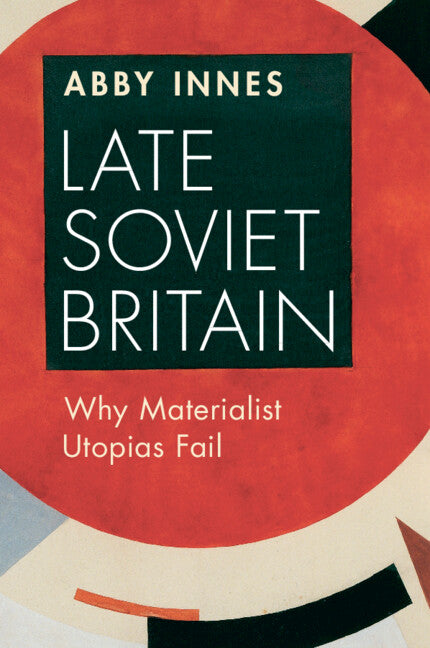
Late Soviet Britain
Why Materialist Utopias Fail
Explains why radical economic liberalism in the UK reproduces Soviet state failures, only now in capitalist form.
Abby Innes (Author)
9781009373630, Cambridge University Press
Paperback / softback, published 28 September 2023
408 pages
22.8 x 15.3 x 2.1 cm, 0.59 kg
'Political dogmatism kills, no matter what its ideological shape and pedigree. Abby Innes has given the most meticulous articulation of an insight that, through Václav Havel's writing, nourished the insurrections against the totalitarian regimes in Eastern Europe. Thanks to her merciless dissection of the totalitarian logic of neo-liberalism and her scrupulous account of the damage it has inflicted on Britain, we should be better equipped to find a way out. In Late Soviet Britain, Abby Innes has recast the Enlightenment project by cleansing it of its modernist hubris. Emancipation without utopia requires politics without dogma, and this book charts a new road ahead.' Albena Azmanova, Author of The Scandal of Reason and the multiple-award-winning Capitalism on Edge
Why has the United Kingdom, historically one of the strongest democracies in the world, become so unstable? What changed? This book demonstrates that a major part of the answer lies in the transformation of its state. It shows how Britain championed radical economic liberalisation only to weaken and ultimately break its own governing institutions. The crisis of democracy in rich countries has brought forward many urgent analyses of neoliberal capitalism. This book explores for the first time how the 'governing science' in Leninist and neoliberal revolutions fails for many of the same reasons. These systems may have been utterly opposed in their political values, but Abby Innes argues that when we grasp the kinship in their closed-system forms of economic reasoning and their strategies for government, we may better understand the causes of state failure in what remains an inescapably open-system reality.
Introduction: the Gods that failed
Part I. The Materialist Utopias: 1. Rationality and closed-system reasoning
2. General equilibrium and the balanced plan
3. On bureaucracy
4. On 'organised forgetting' in the governing science
Part II. Britain's Neoliberal Revolution: 5. The new public management, or Enterprise planning in capitalist form
6. Quasi-markets in welfare, or The non-withering state
7. Tax competition, or The return of regulatory bargaining
8. Efficient markets and climate change, or Soviet cybernetics 2.0
Part III. The Rise and Fall of the Neoliberal 'Movement Regime': 9. Neoliberalism: the Brezhnev years
10. A politics for the end of time.
Subject Areas: Political economy [KCP]