Special Order - allow 2+ weeks lead
Couldn't load pickup availability
Language, the Singer and the Song
The Sociolinguistics of Folk Performance
This book discusses performance in communities of practice, social criticism through song, and how folk song and language interact.
Richard J. Watts (Author), Franz Andres Morrissey (Author)
9781107112711, Cambridge University Press
Hardback, published 31 January 2019
390 pages
23.5 x 15.7 x 2.3 cm, 0.75 kg
'It is an impressive resource for folk musicians, cultural theorists, and sociolinguists alike, and provides a welcome exploration into historical and current aspects of folk song performance and transmission, the timeless stories that folk songs tell, and the communities they build.' Andy Gibson, Language in Society
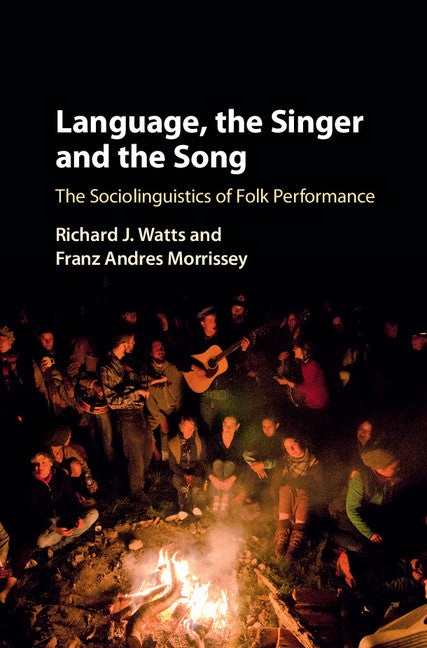
The relationship between language and music has much in common - rhythm, structure, sound, metaphor. Exploring the phenomena of song and performance, this book presents a sociolinguistic model for analysing them. Based on ethnomusicologist John Blacking's contention that any song performed communally is a 'folk song' regardless of its generic origins, it argues that folk song to a far greater extent than other song genres displays 'communal' or 'inclusive' types of performance. The defining feature of folk song as a multi-modal instantiation of music and language is its participatory nature, making it ideal for sociolinguistic analysis. In this sense, a folk song is the product of specific types of developing social interaction whose major purpose is the construction of a temporally and locally based community. Through repeated instantiations, this can lead to disparate communities of practice, which, over time, develop sociocultural registers and a communal stance towards aspects of meaningful events in everyday lives that become typical of a discourse community.
Introduction
Part I. Creating Community and Identity through Song: 1. Language and music
2. 'Breaking through' into performance'
3. The communality of folk song
4. Answering back: rebels with and without a cause
Part II. Variation in Language and Folk Song: 5. 'The times they are a-changing'
6. Ideologies, authenticities and traditions
7. 'Insects caught in amber'
Part III. Folk Song Performance and Linguistics: 8. Voices in the folk song
9. The song: text and entextualisation in performance
10. Going out there and doing your thing
11. Enregisterment through song
12. Whither folk song, whither sociolinguistics?
Appendix: overview of musical concepts.