Freshly Printed - allow 7 days lead
Couldn't load pickup availability
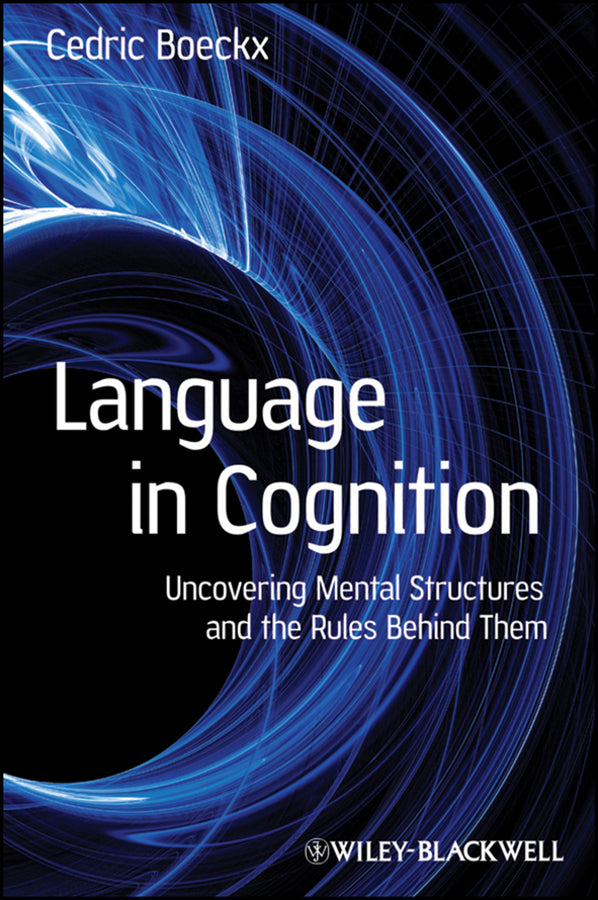
Language in Cognition
Uncovering Mental Structures and the Rules Behind Them
"Boeckx has a deep familiarity with all of the (very wide-ranging) material he presents, and has done original and important work in several of these areas. He is a lucid and engaging expositor, and is highly qualified in every respect to undertake an enterprise of this nature … [He] brings together the right topics, some right at the edge or even at the horizons of research. If I were teaching undergraduate or graduate courses in these areas, I cannot think of a competing text that I would prefer." "No one had integrated, yet, the key four notions "language", "cognition", "mental" and "structures" in such a masterly and original way. A wealth of discoveries awaits both the novice reader and the expert. Cedric's art of revealing deep connections between fields, authors and ideas has frequently prompted me, while reading this book, to wonder why I had not seen those connections before." “If Linguistics is the queen of the cognitive sciences, then Cedric Boeckx is her official court biographer. In one short book, he clearly outlines how the developments in linguistics have upended earlier empiricist conceptions of mind and spurred exciting investigations of human evolution.” “Language in Cognition is not so much a book with facts and concepts, as a long argument and discussion with the reader. It is an argument that every serious student of the mind sciences should know, even if they don't join the choir. Boeckx masterfully presents the material, showing why biology must form a core part of the mind sciences, and how the mind sciences, and especially language, can pose new challenges for biology.” “Cedric Boeckx provides a wonderful, modern review of the necessity of mentalism, of innate structure for all of the mind, and the role of mathematics in articulating different principles of representation for different modules of mind---a summary of the Chomskyan revolution over the last half century. He brings perspective to the project by connecting the history of philosophy with modern experimentation showing that the “generative” approach to both language and mind has received stunning support in acquisition, processing, and aphasia. At the same time, he acknowledges many mysteries: we do not know what our “gut feelings” contain, though they are central to humanity and dignity. They may also contain amalgams combined from different modules in ways we do not understand, but which also may ultimately submit to mathematical representation. The book situates grammar in the broader sciences in a manner accessible to the generally educated student or curious layman. It is a superb introduction to the fundamental role of generative thought in modern cognitive science, weaving together psychological, biological, and philosophical perspectives.”
–Noam Chomsky
–Massimo Piattelli-Palmarini, University of Arizona
–Norbert Hornstein, University of Maryland
–Marc Hauser, Harvard College, Author of Moral Minds
–Tom Roeper, University of Massachusetts, Amherst
Cedric Boeckx (Author)
9781405158817, Wiley
Hardback, published 4 September 2009
264 pages
25.4 x 17.8 x 2.1 cm, 0.635 kg
"Amongst the book's strengths, particularly commendable are the connections made to other cognitive domains and the biological sciences." (The Linguist, July 2010)
"Although each subsection is brief, the author includes chapter-by-chapter notes of cited material at the end of the text. The motivated reader will have no trouble tracking down the primary sources that the author discusses." (PsycCRITIQUES, March 2010)
This textbook explores the ways in which language informs the structure and function of the human mind, offering a point of entry into the fascinating territory of cognitive science. Focusing mainly on syntactic issues, Language in Cognition is a unique contribution to this burgeoning field of study.
Acknowledgments viii Prologue xi Part I Ever Since Chomsky 1 1 Mind Matters: Chomsky’s Dangerous Idea 3 2 The Mechanization of the Mind Picture 14 3 How the Mind Grows: From Meno to Noam 41 Part II Unweaving the Sentence 55 4 Mental Chemistry 57 5 The Variety of Linguistic Experience: The Towers of Babel and Pisa 82 6 All Roads Lead to Universal Grammar 95 Part III The Mental Foundations of Behavior 109 7 Making Sense of Meaning: An Instruction Manual 111 8 Wonderful Mental Life: Unthinkable without Language 120 9 Grammar Caught in the Act 133 Part IV Missing Links 147 10 The (Mis)Measure of Mind 149 11 Homo Combinans 163 12 Computational Organology 173 Epilogue 183 Notes 189 Guide to Further Study 211 References 219 Index 242
Subject Areas: Language: reference & general [CB]