Freshly Printed - allow 8 days lead
Couldn't load pickup availability
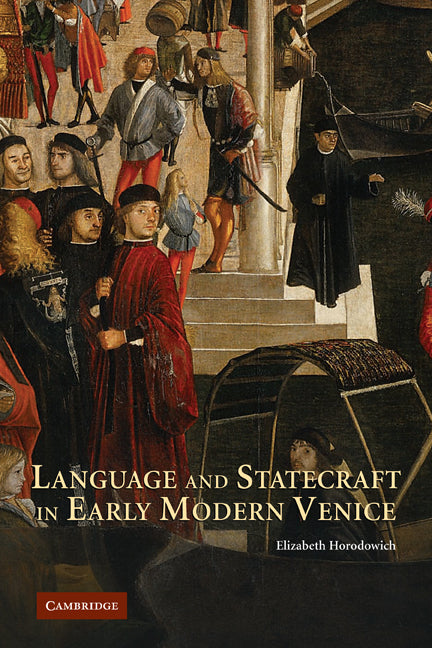
Language and Statecraft in Early Modern Venice
This book demonstrates that a crucial component of statebuilding in Venice was the management of public speech.
Elizabeth Horodowich (Author)
9780521178365, Cambridge University Press
Paperback, published 3 March 2011
258 pages
22.9 x 15.2 x 1.5 cm, 0.38 kg
“Language and Statecraft in Early Modern Venice establishes a fresh context for a number of subjects that have dominated early modern and Renaissance scholarship over the past generation. Elizabeth Horodowich’s analysis of blasphemy, insults, and gossip elegantly demonstrates that the relationship between language and state power was always paradoxical. Gossip was widely denounced in the theoretical literature as the untrustworthy manifestation of female speech, but male gossip in the form of bargaining for favors had a powerful political value. The book will become a model for reinterpreting how citizens spoke to power in the early modern world.” -Edward Muir, Northwestern University
While historians typically describe the state as emerging through a wide variety of processes and structures such as armies, bureaucracies, and administrative organizations, this book demonstrates that a crucial but unrecognized component of statebuilding in Renaissance Venice was the management of public speech: controlling foul language. Ideas about language were deeply embedded in Venetian political culture. Instead of studying the history of language through literary, printed texts, Horodowich examines the speech of everyday people on the streets of Renaissance Venice by looking at their actual words as recorded in archival documents. By weaving together a variety of historical sources, including literature, statutes, laws, chronicles, trial testimony, and punitive sentences, Horodowich shows that the Venetian state constructed a normative language – a language based not only on grammatical correctness, but on standards of politeness, civility, and piety – to protect and reinforce its civic identity.
1. Defining the art of conversation
2. Regulating blasphemy
3. Insults
4. Conversation and exchange: networks of gossip
5. The language of courtesans.
Subject Areas: Early modern history: c 1450/1500 to c 1700 [HBLH], European history [HBJD]