Freshly Printed - allow 10 days lead
Couldn't load pickup availability
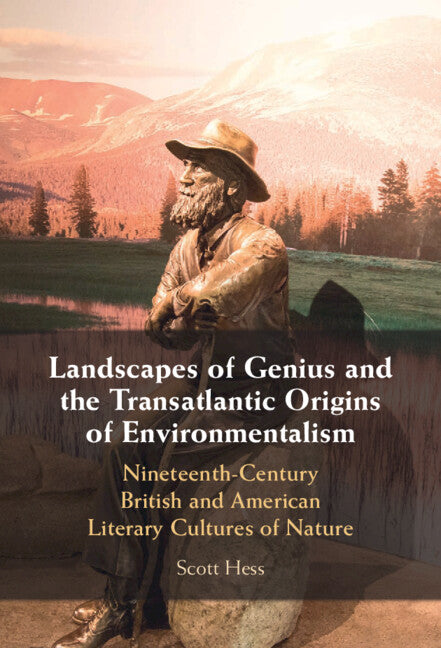
Landscapes of Genius and the Transatlantic Origins of Environmentalism
Nineteenth-Century British and American Literary Cultures of Nature
Scott D. Hess explores how British and American authors' 'genius' became associated with natural landscapes during the nineteenth century.
Scott Hess (Author)
9781009561259, Cambridge University Press
Hardback, published 7 August 2025
292 pages
23.5 x 16 x 2.1 cm, 0.56 kg
'Written with conviction, Landscapes of Genius demonstrates that the history of author-love (especially as it manifests itself in literary landscapes and heritage tourism) is inseparable from Anglo-American environmental history. It will be impossible for future scholars to discuss responsibly the legacy of literary landscapes without also taking environmental politics and impacts into account.' Paul Westover, Professor of English, Brigham Young University
During the nineteenth century, the idea of 'genius' became associated with natural landscapes on both sides of the Atlantic. Scott D. Hess explores how those associations defined the modern significance of nature and precipitated the emergence of National Parks and the environmental movement. William Wordsworth's identification with the English Lake District, Henry David Thoreau's with Walden, and John Muir's with Yosemite established the paradigm of the 'landscape of genius,' through which authors and landscapes entered the nature-writing canon and national high culture. The book also explores the significance of race, gender, and class for such landscapes, as evidenced in writings by African American author Frederick Douglass; American woman writer Susan Fenimore Cooper; and British laboring-class poets Robert Burns, John Clare, and Ann Yearsley. Fundamentally reshaping how we understand nineteenth-century transatlantic cultures of nature, Hess reveals the ongoing legacy of the landscape of genius for environmental politics today.
Introduction
1. Genius: author, nature, nation
2. From Wordsworthshire to Thoreau Country: paradigmatic landscapes of genius
3. Landscapes of class and gender: John Clare, Robert Burns, Ann Yearsley, and Susan Fenimore Cooper
4. Frederick Douglass's literary landscape and the racial construction of nature
5. John Muir's Yosemite and the environmental politics of genius
Conclusion: beyond an environmentalism of genius
Coda: Walden pond in the anthropocene and a relational approach to the humanities
Endnotes
Bibliography
Index.
Subject Areas: Literary studies: c 1800 to c 1900 [DSBF]