Special Order - allow 2+ weeks lead
Couldn't load pickup availability
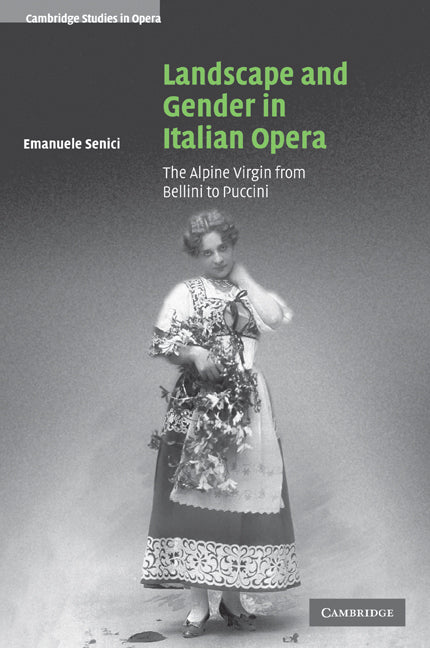
Landscape and Gender in Italian Opera
The Alpine Virgin from Bellini to Puccini
An unusual look at Italian opera in the nineteenth century.
Emanuele Senici (Author)
9780521107785, Cambridge University Press
Paperback / softback, published 29 January 2009
368 pages, 15 b/w illus. 26 music examples
22.9 x 15.2 x 2.1 cm, 0.54 kg
Review of the hardback: '… a wide-ranging interdisciplinary exploration of a major aspect of Romanticism neglected in previous studies of nineteenth-century opera. … There is excellent material on the literary sources … This is a deeply intelligent study.' Musical Times
In this unusual study, Emanuele Senici explores the connection between landscape and gender in Italian opera through the emblematic figure of the Alpine virgin. In the nineteenth century, operas portraying an emphatically virginal heroine, a woman defined by her virginity, were often set in the mountains, most frequently the Alps. The clarity of the sky, the whiteness of the snow and the purity of the air were associated with the 'innocence' of the female protagonist. Senici discusses a number of works particularly relevant to the origins, transformations and meanings of this conventional association including Bellini's La sonnambula (1831), Donizetti's Linda di Chamounix (1842), Verdi's Luisa Miller (1849), and Puccini's La fanciulla del West (1910). This convention presents an unusual point of view - a theme rather than a composer, a librettist, a singer or a genre - from which to observe Italian opera 'at work' over a century.
List of illustrations
List of musical examples
Acknowledgments
1. Virgins, mountains, opera
2. 'At the foot of the Alps': The landscape of La sonnambula
3. Linda di Chamounix and the ideology of chastity
4. The politics of genre in Luisa Miller
5. Deflowering the Alps: from I promessi sposi to La Wally and Fedora
6. La fanciulla del West: a new landscape for a new virgin
Notes
Index.
Subject Areas: Opera [AVGC9], Romantic music [c 1830 to c 1900 AVGC5]