Freshly Printed - allow 7 days lead
Couldn't load pickup availability
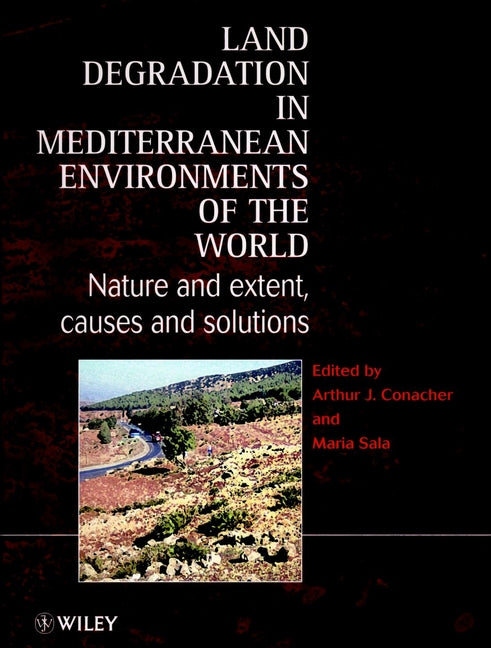
Land Degradation in Mediterranean Environments of the World
Nature and Entent, Causes and Solutions
Arthur J. Conacher (Edited by), Maria Sala (Edited by)
9780471963172, Wiley
Hardback, published 23 April 1998
520 pages
19.7 x 25.4 x 3.5 cm, 1.247 kg
"... it is a valuable piece of work and we recommend it as areference book for any institution's library." EnvironmentalConservation
"This is an impressive work of reference and will be much-used asdebates about desertification and land degradation continue. Thereis much detail, mapping and compilation of statistical information.... this is a splended item of co-operative scholarship andacademic synthesis of a huge amount of information, which otherwisewould be unavailable to students and development practitionersalike." Biodiversity and Conservation
".. this book is a valuable source of material and worth its placein university and college libraries." Progress in PhysicalGeography
Written by specialist and regional contributors, this invaluablebook provides an integrated, up-to-date, geographical assessment ofland degradation in the world's Mediterranean regions.
Land degradation is the alteration of the natural (or biophysical)environment by human actions, causing detrimental effects to thevegetation, soils, landforms, water and ecosystems. Part One ofthis book comprises a brief geography of the Mediterranean climateregions - the Mediterranean basin, California, central Chile, theSouthwest Cape and Southern Australia, providing a context forParts Two and Three. The second section discusses the nature,extent, history, causes and implications of land degradation in theregions. Major problems include soil, vegetation and waterdegradation, fire, drought, flooding and sedimentation. Historicaland contemporary human responses to these problems are alsoconsidered and at times become part of the problem. Solutions -actual and potential - are evaluated in the third section andinclude those dealing with animals, cultivation, horticulture,engineering-type practices, agroforestry, whole farm planning,integrated catchment management and regional planning.
Throughout there is an emphasis on the distinctive nature of theMediterranean-type environments - especially the seasonally, hot,dry climates, the species-rich and highly inflammable vegetation,steep topography and coastal orientations - and the ways in whichthese environments interact with human populations with theircontrasting histories and cultures to result in a special set ofenvironmental problems and response.
THE NATURE OF THE WORLD'S MEDITERRANEAN-TYPE ENVIRONMENTS
Iberian Peninsul and Balearic Islands
The South of France and Corsica
Italy
The Croatian Adriatic Coast
Greece
The Eastern Mediterranean
North Africa
Greater California
Chile
The Southwestern Cape of South Africa
Southern Australia
PROBLEMS OF LAND DEGRADATION
Introduction
The Main Problems of Land Degradation: Their Nature, Extent andSeverity: 1. Erosion and Soil Deterioration, Flooding, VegetationLoss and Degradation
The Main Problems of Land Degradation: Their Nature, Extent andSeverity: 2. Drought, Water Shortages, and Water Quality, and otherForms of Degradation
The Historical Development of Land Degradation in the MediterraneanWorld
The Causes of Land Degradation 1. The Nature of the BiophysicalEnvironment
The Causes of Land Degradation 2. Vegetation Clearing andAgricultural Practices
The Causes of Land Degradation 3. Other Human Actions
Some Broader Implications of Land Degradation
SOLUTIONS TO LAND DEGRADATION
Introduction
Solutions dealing with Animals, Cultivation and HorticulturalPractices
Technical Solutions
Vegetation-Related Solutions
Economic, Social, Agency and Policy Solutions. 1. The MediterraneanBasin
Economic, Social, Agency and Policy Solutions 2. The NewWorld
Summary and Conclusions
Subject Areas: Earth sciences [RB]