Special Order - allow 2+ weeks lead
Couldn't load pickup availability
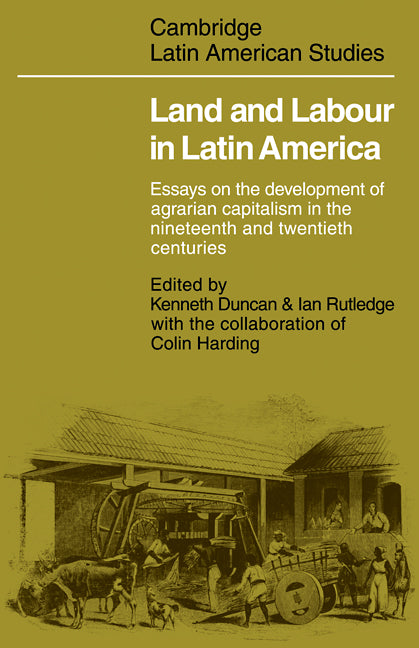
Land and Labour in Latin America
Essays on the Development of Agrarian Capitalism in the nineteenth and twentieth centuries
This book of essays by an international group of scholars represents a substantial empirical contribution to the ongoing debate.
Kenneth Duncan (Edited by), Ian Rutledge (Edited by), Colin Harding (With)
9780521093200, Cambridge University Press
Paperback / softback, published 11 January 2009
552 pages
21.6 x 14 x 3.1 cm, 0.69 kg
There has been considerable controversy amongst social and economic historians, anthropologists, economists, sociologists, political scientists and other specialists concerning the nature and structure of Latin American agrarian society. An increasing number of studies have come to challenge the traditionally accepted view that the backwardness of rural Latin America and its resistance to 'modernisation' are due to the persistence of feudal or non-feudal forms of social and economic organisation. Instead attention has shifted to an examination of the social and economic dislocations resulting from attempts to impose capitalist forms of agrarian enterprise on peasant or pre-capitalist societies. This book of essays by an international group of scholars represents a substantial empirical contribution to the ongoing debate. This book will be of interest not only to specialists in the field, but also to anyone wishing to understand the historical processes underlying contemporary Latin America's complex land tenure and rural employment problems.
List of tables
List of figures
List of maps
Acknowledgements
1. Introduction: patterns of agrarian capitalism in Latin America
Part I. The transition from traditional hacienda to capitalist estate
2. Hacienda profits and tenant farming in the Mexican Bajio, 1700–1860
3. Landlord, labourer and tenant in San Luis Potosi, northern Mexico, 1822–1910
4. Land and labour in rural Chile, 1850–1935
5. The development of the Chilean hacienda system, 1850–1973
6. Relations of production in Andean haciendas: Peru
7. The formation of the coffee estate in nineteenth-century Costa Rica
Part II: The development of a plantation economy with labour recruitment from highland peasant communities
8. The integration of the highland peasantry into the sugar cane economy of northern Argentina, 1930–43
9. The social and economic consequences of modernisation in the Peruvian sugar industry, 1870–1930
10. The dynamics of Indian peasant society and migration to coastal plantations in central Peru
11. A Colombian coffee estate: Santa Barbara, Cundinamarca, 1870–1912
Part III. The development of commercial agriculture using European immigrant labour
12. The coffee colono of Sao Paulo, Brazil: migration and mobility, 1880–1930
13. The cereal boom and changes in the social and political structure of Santa Fe, Argentina, 1870–95
Part IV. The transition from slave plantation to capitalist plantation
14. The consequences of modernisation fro Brazil's sugar plantations in the nineteenth century
15. From bangue to usina: social aspects of growth and modernisation in the sugar industry of Pernambuco, Brazil, 1850–1920
16. The evolution of rural wage labour in the Cauca Valley of Colombia, 1700–1970
17. The post-emancipation origins of the relationships between the estates and the peasantry in Trinidad
Part V. Postscript
18. Latin American 'landlords' and 'peasants' and the outer world during the national period
19. Abstracts of other papers
Glossary
Weights and measures
Notes on contributors
Indexes.
Subject Areas: General & world history [HBG]