Special Order - allow 2+ weeks lead
Couldn't load pickup availability
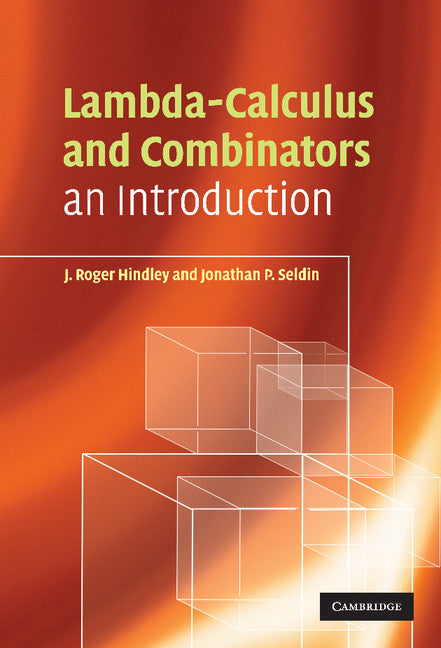
Lambda-Calculus and Combinators
An Introduction
This book gives an account of combinatory logic and lambda-calculus models.
J. Roger Hindley (Author), Jonathan P. Seldin (Author)
9780521898850, Cambridge University Press
Hardback, published 24 July 2008
358 pages, 10 b/w illus. 1 table 55 exercises
23.5 x 15.4 x 2.3 cm, 0.61 kg
'Without doubt this is a valuable treatment of a venerable topic that rewards those who understand it. The authors successfully promulgate their tradition, and that is certainly more important than providing full proofs for every result.' The Journal of JFP
Combinatory logic and lambda-calculus, originally devised in the 1920s, have since developed into linguistic tools, especially useful in programming languages. The authors' previous book served as the main reference for introductory courses on lambda-calculus for over 20 years: this version is thoroughly revised and offers an account of the subject with the same authoritative exposition. The grammar and basic properties of both combinatory logic and lambda-calculus are discussed, followed by an introduction to type-theory. Typed and untyped versions of the systems, and their differences, are covered. Lambda-calculus models, which lie behind much of the semantics of programming languages, are also explained in depth. The treatment is as non-technical as possible, with the main ideas emphasized and illustrated by examples. Many exercises are included, from routine to advanced, with solutions to most at the end of the book.
Preface
1. The λ-calculus
2. Combinatory logic
3. The power of λ and CL
4. Computable functions
5. Undecidability
6. Formal theories
7. Extensionality in λ-calculus
8. Extensionality in CL
9. Correspondence between λ and CL
10. Simple typing, Church-style
11. Simple typing, Curry-style in CL
12. Simple typing, Curry-style in λ
13. Generalizations of typing
14. Models of CL
15. Models of λ
16. Scott's D∞ and other models
Appendix 1. α-conversion
Appendix 2. Confluence proofs
Appendix 3. Normalization proofs
Appendix 4. Care of your pet combinator
Appendix 5. Answers to starred exercises
Bibliography
Index.
Subject Areas: Mathematical theory of computation [UYA], Mathematical logic [PBCD]