Freshly Printed - allow 7 days lead
Couldn't load pickup availability
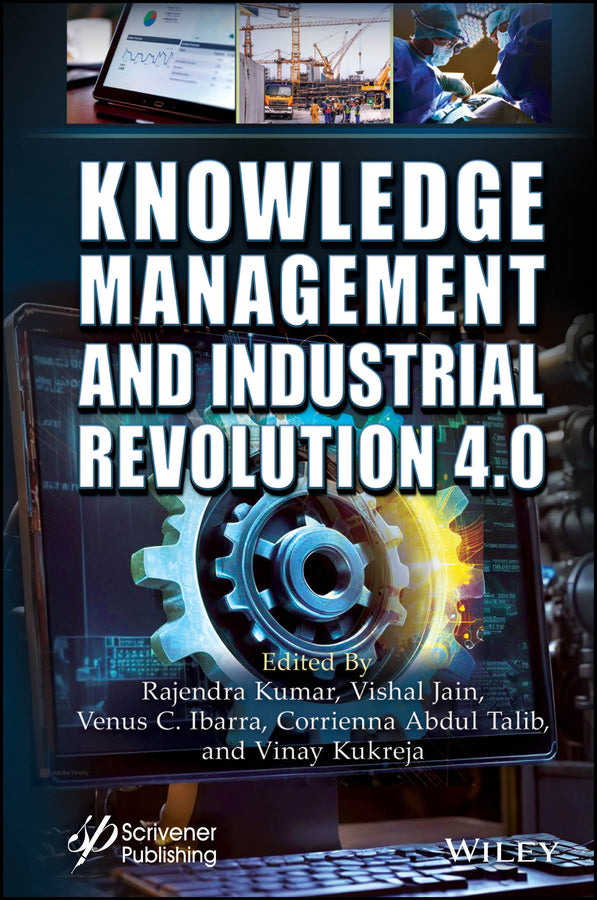
Knowledge Management and Industrial Revolution 4.0 – Practices and Challenges
Practices and Challenges
Kumar (Author)
9781394242610, Wiley
Hardback, published 14 October 2024
448 pages
22.9 x 15.2 x 2.7 cm, 0.7 kg
Get up to speed with how the latest knowledge management and industry 4.0 technologyhelp make enterprises secure, controlled, and optimized for a better future. This book focuses on how the practices of Industrial Revolution 4.0 and knowledge management interact to create value. In recent years, value chain relationships and related activities have utilized new technologies so that existing conceptual frameworks require a roadmap for innovation strategies and effective implementation. The chapters in this book include case studies contributed by researchers and industry practitioners that showcase the impact of practices and challenges presented by technological changes, upgrading of old systems, and internal and external factors. Knowledge Management and Industrial Revolution 4.0 describes how knowledge management impacts the automation of the industry in secure, controlled, and optimized ways. For instance, the use of the latest technologies and sensors can lead to significant time and cost savings, and operators can utilize their machines and equipment from remote locations. The Industrial Revolution 4.0 incorporates the latest technologies for automation and, in many cases, the result is similar to working from home, even in manufacturing. The use of deep learning should offer many quality control benefits. Furthermore, blockchain technology can help the industry with automation in secure and transparent ways. Apart from industry automation, other departments like human resources can also use effective knowledge management for better outcomes. The use of HR knowledge management allows employees to find and access the information they require without the assistance of the HR department. The book focuses on every aspect of the industry to help all the stakeholders of an organization. The benefits include a reduction in time required for accessing information, easier training, decreased operational expenses, improved stakeholders’ satisfaction, faster problem-solving, increased pace of innovation, simpler employee review and progress reports. Audience The book will have a wide audience within academia, education, businesses, and industrial organizations, especially those who are undergoing industry 4.0 changes to optimize for a better future.
Preface xix Acknowledgement xxiii 1 The 5G Technology IR4 and Knowledge Management 1 2 Impact of Knowledge Management on Industry 4.0 21 3 Synergizing Knowledge Management in the Era of Industry 4.0: A Technological Revolution for Organizational Excellence 39 4 Improving Manufacturing: Organizational Innovation Through Effective Knowledge Management, A McElroy Knowledge Life Cycle Approach 87 5 Industry 4.0 Trends and Strategies: A Modern Approach with Focus on Knowledge Management 111 6 Artificial Intelligence on Knowledge Management and Industry Revolution 4.0: Impacts and Challenges 159 7 Blending of Knowledge Management with Industry 4.0: A New Formula for Success! 183 8 Modern Approaches and Implications Toward Industry 4.0 197 9 Managing Knowledge in the Era of Industry 4.0: Challenges and Strategies 239 11 Industrialized Control and Automation System (ICAS): A Software-Defined Analysis Framework for Industry 4.0 299 12 Structural Understanding of the Relationship Between Various Consciousness of Programming and Creative Attitudes as Part of Knowledge Management Process 333 13 Blended-Mode Instruction for Knowledge Management Toward IR4.0: Exemplars in Lifelong STREAM Education and The Way Forward 351 14 Insight Review on Advanced Digital Manufacturing Technology Solutions for Industry 4.0 371 15 Enhancing Students’ Learning Achievement, 21st-Century Skills, and Self-Regulation Skills—Knowledge Management and Education 4.0 Perspective 389 Index 413
Vyshali Rao K. P., Shanthi M. B. and Sudhakar K. N.
Amala J. and Anitha K.
Anita Mohanty, Bright Keswani, Subrat Kumar Mohanty, Ambarish G. Mohapatra, Sasmita Nayak and Md Mobin Akhtar
Arpita Nayak, Atmika Patnaik, Ipseeta Satpathy, Vishal Jain, B.C.M. Patnaik and Majidul Islam
Tarun Kumar Vashishth, Vikas Sharma, Kewal Krishan Sharma, Bhupendra Kumar, Sachin Chaudhary and Rajneesh Panwar
Srideviand Tukkappa K. Gundoor
Kavitha R. Gowda, Sunanda Vincent Jaswant, Joseph Varghese Kureethara and Jayanta Banerjee
Bishnu Kant Shukla, Amit Tripathi, Gaurav Bharti, Bhupender Parashar, Nitin Bhardwaj, Aakash Gupta and Shivam Verma
Pawan Whig, Jhansi Bharathi Madavarapu, Nikhitha Yathiraju and Ramya Thatikonda
Karthikeyan V., Dani Reagan Vivek J., Gopalakrishnan K. and Ezhil Kalaimannan
Masanori Fukui, Eng Tek Ong, Khar Thoe Ng, Yoon Fah Lay and Subuh Anggoro
Kamolrat Intaratat, Guan Xing Zhi, Subuh Anggoro, Khar Thoe Ng and Dungkamol Intaratat
D. David Neels Ponkumar, K. Saravanan, Riboy Cheriyan and Chinnadurai Manthiramoorthy
Maria Cindy F. Cardona, Amelia T. Buan, Ellen D. Inutan and Rajendra Kumar