Freshly Printed - allow 10 days lead
Couldn't load pickup availability
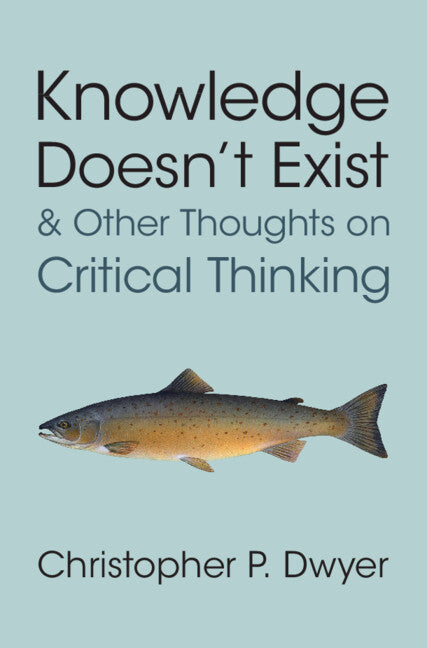
Knowledge Doesn't Exist and Other Thoughts on Critical Thinking
Offers an accessible, evidence-based guide to applying critical thinking in real-world settings amidst today's rapidly expanding information.
Christopher P. Dwyer (Author)
9781009602730, Cambridge University Press
Hardback, published 21 August 2025
200 pages
22.9 x 15.2 x 1.3 cm, 0.441 kg
Dwyer's book covers so much necessary information in such a compact format that one ends up thinking, 'It really can't be that easy.' But it is. Dwyer goes right to the heart of the major issues involved in critical thinking, ranging into cognitive science, social psychology, the media, creativity, and more. It truly is a tour de force by an author who has thought long and hard about the knottiest problems in critical thinking. John Eigenauer, Professor of Philosophy, Taft College
Critical thinking (CT) is essential in education, the workplace, and everyday life, yet many struggle to understand or apply it effectively. This book breaks down the 'what, how, and when' of CT in a clear, accessible way, making it practical for readers from all walks of life. Drawing on over fifteen years of researching CT, Dwyer presents accessible evidence-based lessons and strategies for using CT in real-world situations, helping readers navigate the overwhelming flood of information we face daily. Written in an informal, engaging tone, this book makes CT approachable for anyone looking to improve their decision-making skills.
Foreword
An introduction
1. What exactly is critical thinking'?
2. When and why do we think critically?
3. Knowledge doesn't exist: the nature of certainty and problems with 'theory' and 'proof'
4. Understanding the flaws of experience and memory
5. Evaluating information sources and credibility
6. Changing minds
7. Eureka moments, problem-solving and creativity
8. Critical thinking training
9. Implications of social psychology on critical thinking and practical lessons learned in recent years
10. How can we really think critically? Engaging and expressing critical thinking in our everyday lives.
Subject Areas: Cognition & cognitive psychology [JMR]