In Stock - dispatch within 48 hours
Couldn't load pickup availability
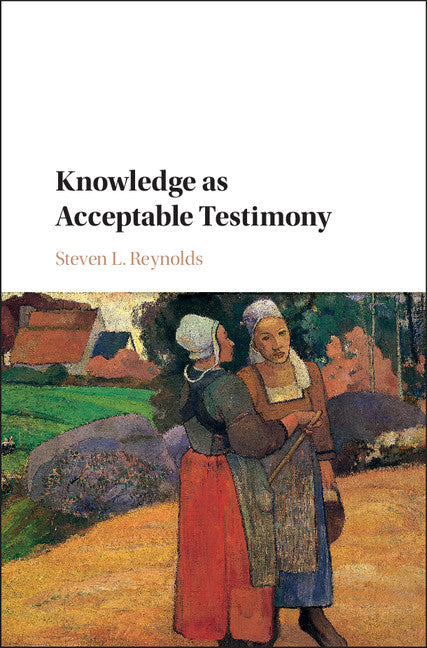
Knowledge as Acceptable Testimony
This book explains how the concept of knowledge functions to improve our system of linguistic information exchange, by comparison with social norms.
Steven L. Reynolds (Author)
9781107197756, Cambridge University Press
Hardback, published 22 June 2017
222 pages
23.5 x 15.6 x 1.5 cm, 0.43 kg
'Reynolds (Arizona State Univ) makes his case with lucid, evenhanded arguments, comparing his position to previous theories and trying to counter anticipated objections.' S. E. Forschler, CHOICE
Standard philosophical explanations of the concept of knowledge invoke a personal goal of having true beliefs, and explain the other requirements for knowledge as indicating the best way to achieve that goal. In this highly original book, Steven L. Reynolds argues instead that the concept of knowledge functions to express a naturally developing kind of social control, a complex social norm, and that the main purpose of our practice of saying and thinking that people 'know' is to improve our system for exchanging information, which is testimony. He makes illuminating comparisons of the knowledge norm of testimony with other complex social norms - such as those requiring proper clothing, respectful conversation, and the complementary virtues of tact and frankness - and shows how this account fits with our concept of knowledge as studied in recent analytic epistemology. His book will interest a range of readers in epistemology, psychology, and sociology.
1. Social norms, knowledge, and philosophy
2. What is knowledge?
3. Developing a concept of knowledge
4. Is that our concept of knowledge?
5. What is justified belief?
6. Justified belief is the appearance of knowledge
7. Testimonial knowledge and social norms
8. Knowledge from testimony
9. Doxastic voluntarism and epistemic evaluations
10. Why we should prefer knowledge.
Subject Areas: Philosophy: epistemology & theory of knowledge [HPK]