Special Order - allow 2+ weeks lead
Couldn't load pickup availability
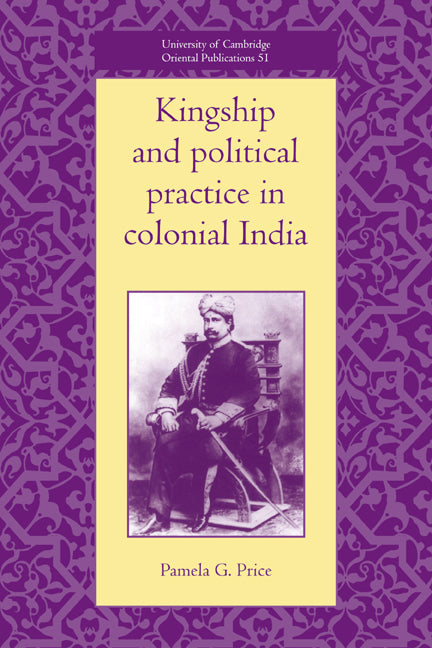
Kingship and Political Practice in Colonial India
This 2006 book considers the transformation of southern Indian institutions under British colonial rule, focusing on the two former 'little kingdoms' of Ramnad and Sivaganga.
Pamela G. Price (Author)
9780521052290, Cambridge University Press
Paperback / softback, published 3 December 2007
244 pages, 7 b/w illus. 1 map
22.9 x 15.1 x 1.5 cm, 0.378 kg
'The strength of Price's book is to consider honour and ritual not as means to a political end, but as independent ends in themselves … the text is the product of careful research … Using methodological insights from Weberian sociology and steeped in the anthropology of South Asia, Price has produced a cultural history which argues, contra Dirks, for the continuity and evolution of royal symbols and values under colonial rule and in contemporary south India.' Social Anthropology
In this 1996 cultural history which considers the transformation of south Indian institutions under British colonial rule in the nineteenth century, Pamela Price focuses on the two former 'little kingdoms' of Ramnad and Sivaganga which came under colonial governance as revenue estates. She demonstrates how rivalries among the royal families and major zamindari temples, and the disintegration of indigenous institutions of rule, contributed to the development of nationalism and identity amongst the people of southern Tamil country. The author also shows how religious symbols and practices going back to the seventeenth century were reformulated and acquired a new significance in the colonial context. Arguing for a reappraisal of the relationship of Hinduism to politics, Price finds that these symbols and practices continue to inform popular expectation of political leadership today.
List of illustrations
Acknowledgements
Glossary
Introduction
1. Honour, status and state formation in seventeenth- and eighteenth-century Maravar country
2. Cosmological fragmentation in the public sphere
3. Domain formation in mid-nineteenth-century Ramnad
4. Human and divine palaces in the fragmentation of monarchical cosmology
5. Ritual performances, the ruling person and the public
6. Raja Baskara Setupati and the emergence of a new political style
Conclusion
Bibliography
Index.
Subject Areas: Asian history [HBJF]