Freshly Printed - allow 10 days lead
Couldn't load pickup availability
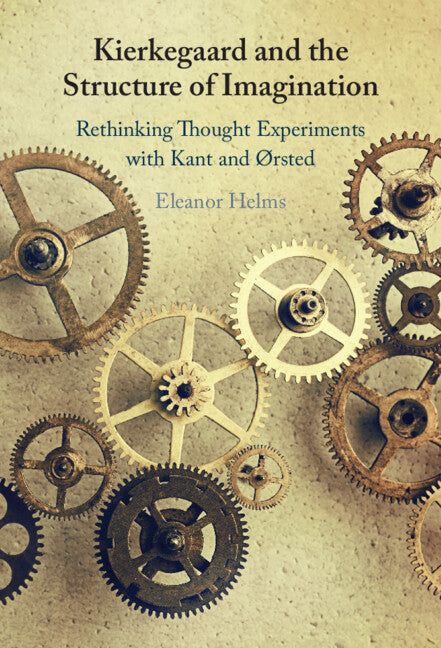
Kierkegaard and the Structure of Imagination
Rethinking Thought Experiments with Kant and Ørsted
Examines H. C. Ørsted's use of thought experiments and his influence on Kierkegaard, arguing that both were inspired by Kant.
Eleanor Helms (Author)
9781009594936, Cambridge University Press
Hardback, published 16 October 2025
296 pages
22.9 x 15.2 x 1.8 cm, 0.592 kg
'Helms shows how H. C. Ørsted and Søren Kierkegaard both develop sophisticated accounts of thought experiments long before Ernst Mach (who is widely credited with introducing the term 'thought experiment'). Her book is indispensable reading for scholars working on Kant, Ørsted, and Kierkegaard as well as those who work on thought experiments (and related conceptual history).' Roe Fremstedal, Norwegian University of Science and Technology
Thought experiments play an important role in philosophy and philosophical theorizing. In this book Eleanor Helms examines thought experiments and charts their use in the work of Danish thinkers Hans Christian Orsted (1777–1851) and Soren Kierkegaard (1813–55), arguing that both were influenced by Kant. She demonstrates how key Kantian concepts shape the methods of both thinkers, especially Kant's claim that regulative ideas like the self, God, and nature cannot be directly represented. Kant proposed some ways in which we can make sense of, or 'cognize,' these kinds of abstract ideas, and Ørsted and Kierkegaard take up the practical challenge of realizing Kant's optimism by designing thought experiments to make these big ideas meaningfully accessible to individual thinkers. Helms's book is the first comprehensive study of Kierkegaard's use of thought experiments as a method, and reveals its significance for our contemporary understanding of how thought experiments work.
Introduction
Part I. The Origins of 'Thought Experiment' in Kant and Ørsted: 1. Thought experiments as tools of cognition
2. How thought experiments work
3. Ørsted, mach, and the history of thought experiment
4. Empiricism and kantian accounts of thought experiment
5. Rationalism and the question of intellectual intuition
Part II. A Kantian Account of Thought Experiment: 6. Varieties of cognition
7. An Apparatus for cognition
8. Cognizing regulative ideas
9. Bizarre cases and context: two problems for thought experiments
Part III. Kierkegaard and the Concept of Thought Experiment: 10. Kierkegaard and the concept of thought experiment
11. Controlled experiments
12. Repetition as thought experiment: a method of variation
13. Kantian strains in stages on life's way
14. Cognition as synthesis
Conclusion
Bibliography
Index.
Subject Areas: Western philosophy: c 1600 to c 1900 [HPCD]