Special Order - allow 2+ weeks lead
Couldn't load pickup availability
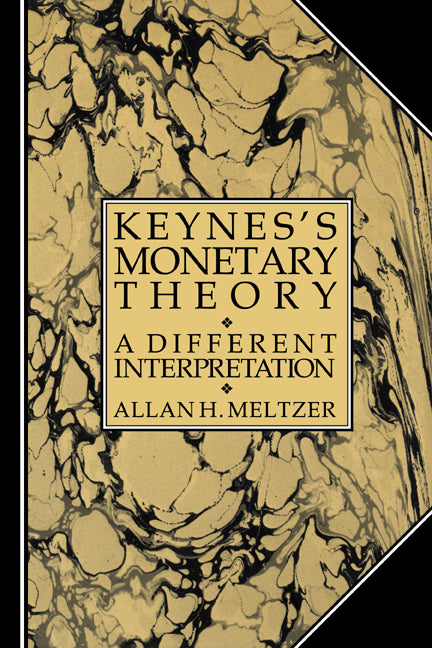
Keynes's Monetary Theory
A Different Interpretation
This rigorous 2009 study of Keynes's views on economic theory and policy from 1920-1946 argues that some of Keynes's main ideas have been ignored or misstated.
Allan H. Meltzer (Author)
9780521022750, Cambridge University Press
Paperback / softback, published 3 November 2005
356 pages
22.9 x 15.4 x 2 cm, 0.543 kg
'This careful and conscientious account can be strongly recommended to any serious economist - to Keynes's faithful followers as well as to those many more who condemn him.' Lorie Tarshis, Journal of Economic Literature
In this rigorous 1989 study of John Maynard Keynes's views on economic theory and policy from 1920–46, Professor Meltzer argues that some of Keynes's main ideas have been ignored or misstated. While attention has focused on short-term countercyclical policies, the main policy implications have been neglected. Keynes placed great emphasis on rules, predictability, and reduction of uncertainty. In keeping with his theoretical work, he opposed discretionary fiscal changes and favored rules to reduce instability and increase the capital stock. These policies are consistent with, and provide evidence for, the interpretation of Keynes's theory developed here.
Preface
1. Introduction
2. Keynes in the 1920s: ideas, beliefs, and events
3. Theories, implications, and conjectures in the 1920s
4. The General Theory: a different perspective
5. Monetary reform and international economic order
6. Other interpretations of The General Theory
7. Conclusion
References
Index.
Subject Areas: Monetary economics [KCBM]