Freshly Printed - allow 10 days lead
Couldn't load pickup availability
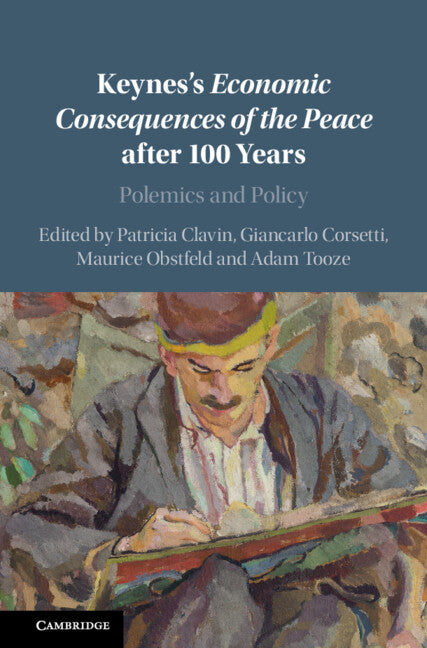
Keynes's Economic Consequences of the Peace after 100 Years
Polemics and Policy
In a turbulent world, Keynes's warnings of a century ago are no less relevant – and some even more so.
Patricia Clavin (Edited by), Giancarlo Corsetti (Edited by), Maurice Obstfeld (Edited by), Adam Tooze (Edited by)
9781009407519, Cambridge University Press
Hardback, published 25 January 2024
468 pages
23.5 x 15.7 x 2.8 cm, 0.91 kg
'John Maynard Keynes would be pleased to know that the savage attack he wrote on the peace settlements at the end of the First World War is still, a century later, provoking comment and debate. A distinguished team drawn from the leading experts on the period examine afresh, with insight and learning, the great and difficult questions of how to make peace after a long and exhausting conflict and build a stable new world order. Stimulating, timely and important.' Margaret MacMillan, Emeritus Professor of International History at the University of Oxford
The Economic Consequences of the Peace is one of the most famous books in the history of economic thought. It is also one of the most polemical. Published as a response to what Keynes saw as the grave errors of the Treaty of Versailles, the book predicted that war reparations and other harsh terms imposed on Germany would lead to its collapse, which in turn would lead to devastating consequences for Europe and the wider world. Predictions that we now know to have been all too accurate. Keynes's Economic Consequences of the Peace after 100 Years brings together an international team of experts to assess the legacy of Keynes's best-selling work. It compiles a series of wide-ranging chapters, exploring the varied influence of his ideas and policy contributions. Written in an accessible style, it recovers the importance of this history and examines the continued relevance of Keynes's controversial book.
1. Lessons of Keynes's economic consequences in a turbulent century Patricia Clavin, Giancarlo Corsetti, Maurice Obstfeld and Adam Tooze
2. The making of a classic: Keynes and the origins of the economic consequences of the peace Michael Cox
3. 'Keynes's economic consequences (1919): the book and its critics' Peter Clarke
4. ' Too bad to be true' Swedish economists on Keynes's the economic consequences of the peace and the German reparations, 1919–1929 Benny Carlson and Lars Jonung
5. Revisionism as intellectual‒political vindication or the French receptions of consequences after the two world wars (1919–46)
6. Between Cambridge, Paris, and Amsterdam Harold James and Andrew Koger
7. Keynes, the transfer problem, and how to pay for war reparations Simon Hinrichsen
8. The speculative consequences of the peace Olivier Accominotti, David Chambers and James Ashley Morrison 9. Why was Keynes opposed to reparations and Carthaginian peace? Elise S. Brezis
10. The one case where economic consequences of the peace mattered: the reshaping of economic mindset in early republican Turkey Eyüp Özveren
11. Keynes and international trade politics after the first world war Madeleine Dungy
12. Gold, international monetary corporation, and the tripartite agreement of 1936 Max Harris
13. Exchange rates, tariffs and prices in 1930s' Britain Jagjit S. Chadha, Jason Lennard, Solomos Solomou and Ryland Thomas
14. 'Unusual, unstable, complicated, unreliable and temporary' reinterpreting the Ebb and flow of globalization Michael D. Bordo and Catherine R. Schenk
15. Keynes's arc of discovery: from the economic consequences to Bretton woods David Vines
16. Keynes, the economic consequences of the peace, and popular perceptions of the first world war' Jonathan Boff.
Subject Areas: Economic theory & philosophy [KCA]