Freshly Printed - allow 10 days lead
Couldn't load pickup availability
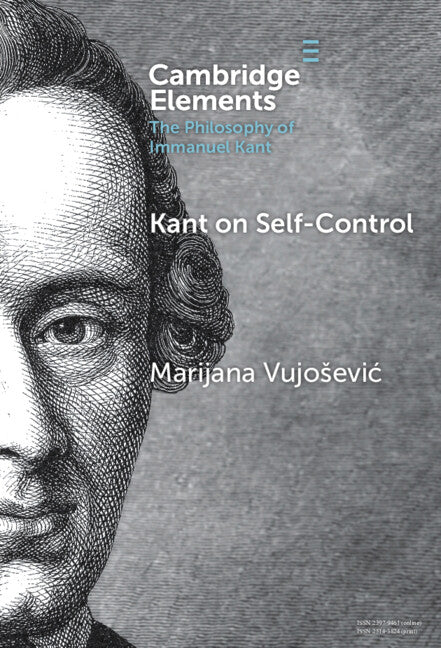
Kant on Self-Control
This Element disputes the widespread, purely instrumental interpretation of Kant's conception of self-control and develops an alternative, fuller account.
Marijana Vujošević (Author)
9781009486767, Cambridge University Press
Hardback, published 20 June 2024
72 pages
22.9 x 15.2 x 0.6 cm, 0.227 kg
This Element considers Kant's conception of self-control and the role it plays in his moral philosophy. It offers a detailed interpretation of the different terms used by Kant to explain the phenomenon of moral self-control, such as 'autocracy' and 'inner freedom'. Following Kant's own suggestions, the proposed reading examines the Kantian capacity for self-control as an ability to 'abstract from' various sensible impressions by looking beyond their influence on the mind. This analysis shows that Kant's conception of moral self-control involves two intimately related levels, which need not meet the same criteria. One level is associated with realizing various ends, the other with setting moral ends. The proposed view most effectively accommodates self-control's role in the adoption of virtuous maxims and ethical end-setting. It explains why self-control is central to Kant's conception of virtue and sheds new light on his discussions of moral strength and moral weakness.
1. Introduction
2. Self-Control through the Lens of 'Autocracy'
3. Self-Control as Abstraction and Inner Freedom
4. A Twofold Account of Moral Strength
5. Moral Weakness: The Other Side of the Coin
6. Concluding Remarks
References.
Subject Areas: Philosophy [HP]