Freshly Printed - allow 10 days lead
Couldn't load pickup availability
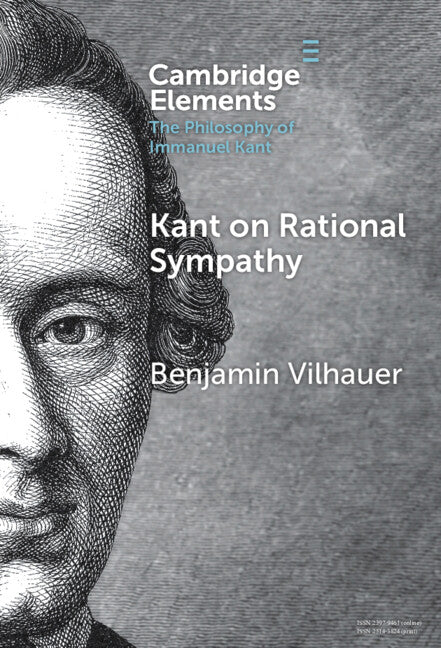
Kant on Rational Sympathy
Contrary to what Kant scholars might think, Kant has a theory of rational sympathy which is essential to his ethics.
Benjamin Vilhauer (Author)
9781009486606, Cambridge University Press
Hardback, published 2 January 2025
74 pages
23.5 x 16 x 0.8 cm, 0.253 kg
This Element explains Kant's distinction between rational sympathy and natural sympathy. Rational sympathy is regulated by practical reason and is necessary for adopting as our own those ends of others which are contingent from the perspective of practical rationality. Natural sympathy is passive and can prompt affect and dispose us to act wrongly. Sympathy is a function of a posteriori productive imagination. In rational sympathy, we freely use the imagination to step into others' first-person perspectives and associate imagined intuitional contents with the concepts others use to communicate their feelings. This prompts feelings in us that are like their feelings.
1. Introduction
2. The Distinction Between Rational and Natural Sympathy
3. A Debate about Translating Doctrine of Virtue §§34-5, and a Concern about Passivity
4. Sympathy and the Imagination
5. Putting Ourselves in Others' Places
6. Correctly Communicating Feeling
7. What Problem in Kant's Ethics is Solved by Rational Sympathy?
8. Responding to Exclusionists, and Distinguishing Adopting and Promoting Ends
9. How Rational Sympathy Allows Adoption of Merely Permissible Ends
10. Sages and Sympathy in Kant's Theory of Friendship
11. Friendship as an Ideal of Sharing All Our Ends and All Our Feelings
12. Four Objections to the Rationally Sympathetic Interpretation of Friendship
13. Sympathy as a Moral Incentive, and its Relationship to Respect
14. Contemporary and Historical Connections to Empathy
15. Conclusion
Bibliography.
Subject Areas: History of Western philosophy [HPC]