Freshly Printed - allow 10 days lead
Couldn't load pickup availability
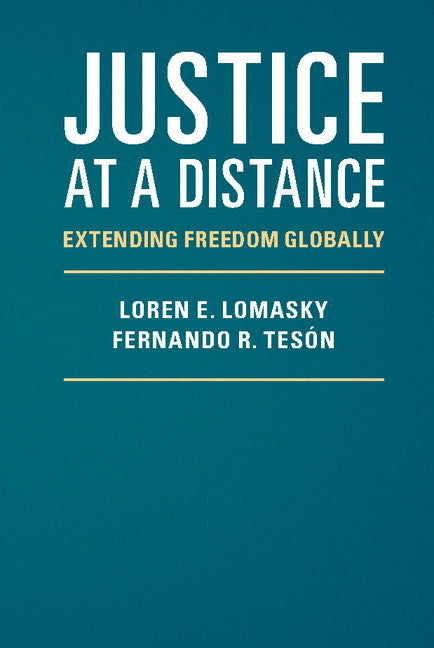
Justice at a Distance
Extending Freedom Globally
Justice at a Distance argues that global justice is largely caused by ill-designed local political structures, not because of insufficient aid.
Loren E. Lomasky (Author), Fernando R. Tesón (Author)
9781107536029, Cambridge University Press
Paperback / softback, published 29 September 2015
293 pages
22.9 x 15.2 x 1.7 cm, 0.43 kg
'Justice at a Distance presents a powerful case that justice requires letting others alone. This seemingly simple directive has the potential to massively improve the welfare of individuals across the globe. With their sophisticated grasp of economics, philosophy, and law, Lomasky and Tesón persuasively demonstrate that the best way to help people is to stop hurting them through ill-conceived policies, such as trade and immigration restrictions, that continue to immiserate the world's poor.' Jonathan Klick, University of Pennsylvania
The current global-justice literature starts from the premise that world poverty is the result of structural injustice mostly attributable to past and present actions of governments and citizens of rich countries. As a result, that literature recommends vast coercive transfers of wealth from rich to poor societies, alongside stronger national and international governance. Justice at a Distance, in contrast, argues that global injustice is largely home-grown and that these native restrictions to freedom lie at the root of poverty and stagnation. The book is the first philosophical work to emphasize free markets in goods, services, and labor as an ethical imperative that allows people to pursue their projects and as the one institutional arrangement capable of alleviating poverty. Supported by a robust economic literature, Justice at a Distance applies the principle of noninterference to the issues of wealth and poverty, immigration, trade, the status of nation-states, war, and aid.
1. The state of the world
2. What do we owe distant others?
3. Choosing wealth, choosing poverty
4. Immigration
5. Emigration and the brain drain objection
6. Justice and trade
7. States
8. War, self-defense, and humanitarian intervention
9. Beyond justice at a distance.
Subject Areas: Public international law [LBB], Politics & government [JP], Social & political philosophy [HPS]